

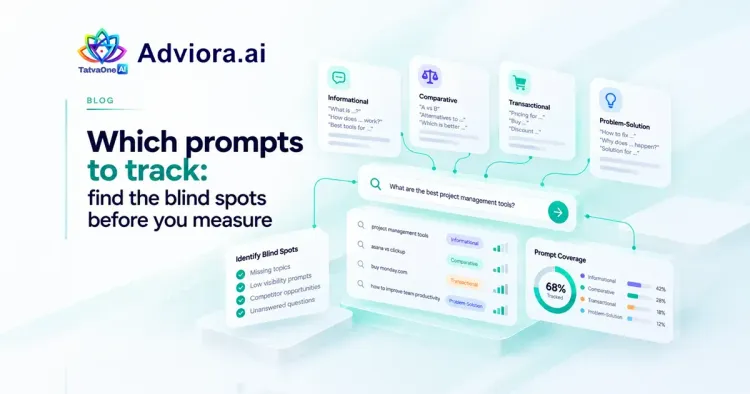
Which prompts should you track for AI visibility?
The questions a shopper asks while they're still choosing. Take a made-up D2C skincare brand, Dewbloom, selling online in India. "Best sunscreen for oily skin under ₹500" or "which natural skincare brands suit sensitive skin?" tells Dewbloom far more than "what is Dewbloom?", because the shopper hasn't decided yet and the AI assistant gets to pick. That's where Generative Engine Optimization (GEO) and Answer Engine Optimization (AEO) work either pays off or doesn't.
Kevin Indig, who led SEO at Shopify, G2 and Atlassian, has argued that prompt tracking should work more like polling or a focus group than like rank tracking (Growth Memo, H1 2026). You're sampling what a population of buyers might hear, so the questions need to resemble what that population actually asks.
What's the difference between branded and discovery prompts?
A branded prompt names you: "What is Dewbloom?" or "Is Dewbloom sunscreen safe for sensitive skin?" You'll usually show up in those answers. They're worth tracking for a different reason, because they show how engines describe you, including any outdated or wrong facts.
A discovery prompt is the question someone asks before they have a shortlist. Brands that look strong on their own name often disappear here, and this is where new buyers come from. Keep a handful of branded prompts as a control group and build most of the set from discovery questions.
How many prompts should you track?
There's no single right number. As a working range, we'd start with roughly 30 to 50 prompts per product and market, with the large majority unbranded. Sell one product in one country? Start at the lower end. Sell several products, or in several markets or languages, and you'll want a separate set for each rather than one set stretched thin across all of them.
Keep a floor in mind too. Adviora only labels a figure high confidence when it rests on at least 100 observations across at least 10 prompts and 3 runs (methodology). Below that, small changes in a single answer can swing the result.
More prompts don't make the numbers more accurate by themselves. A set of 40 well-chosen questions tells you more than 200 that all ask the same thing in different words.
Where do good prompts come from?
- Write prompts the way buyers ask, which is rarely the way your team describes the product. Three sources do most of the work.
- Start with your own site. List the products, audiences, problems and markets your pages cover, and turn each into a question a buyer might ask.
- Then use Google. Related searches and People Also Ask boxes show real phrasing, and you can rewrite each one as a conversational prompt.
- Finally, read your support tickets, product reviews and marketplace Q&A. Shoppers ask about ingredients, sizing, delivery and returns there in their own words, and keyword tools miss most of it.
- Adviora builds its prompt panels from the same sources. It crawls your site to work out what you sell, who you sell it to and how you describe it, then adds search results data, turning People Also Ask questions into prompts while keeping the original questions too.
How do you turn a search query into a prompt?
People type short queries into Google and ask longer questions of AI assistants. Rewrite each search the way a buyer would say it out loud, with their situation included:
| Source | What people type or ask | Prompt to track |
| Search query | "sunscreen oily skin india" | "Which sunscreen works best for oily, acne-prone skin in India's humidity?" |
| People Also Ask | "Is mineral sunscreen better for sensitive skin?" | "Is mineral sunscreen better for sensitive skin, and which brands make a good one?" |
| Product review | "Leaves a white cast on darker skin" | "Which sunscreens don't leave a white cast on darker skin tones?" |
Add the shopper's skin type, budget, city or constraint wherever it matters, because it changes which brands the engines name. It's also worth tracking two or three phrasings of your most important questions. In Kevin Indig's analysis of 1.2 million ChatGPT responses, 58% of cited URLs appeared for only one prompt (Growth Memo), so a small change in wording can bring up a different set of sources.
How should you group prompts by buying stage?
| Stage | Example prompt | What a miss usually means |
| Discovery | "Best natural skincare brands for sensitive skin" | Gift guides, review sites and marketplace lists don't include you |
| Comparison | "Is Dewbloom better than the big drugstore sunscreen brands?" | Your product pages don't answer the comparison clearly |
| Requirement | "Which sunscreens are fragrance-free and reef-safe?" | Ingredients and certifications aren't stated where engines look |
| Purchase | "Where can I buy Dewbloom sunscreen with fast delivery in Bengaluru?" | Price, stock or delivery facts are missing or out of date |
Grouping by stage tells you where to start fixing. A gap at discovery points to third-party coverage, a gap at comparison points to your own pages, and a gap at purchase usually means the engines have wrong or old facts about your price, stock or delivery. Adviora tags every prompt in a panel to a buying stage for this reason.
Why should you freeze your prompt set?
Because otherwise you can't tell what changed. Once you've chosen the set, give it a version number and leave it alone between runs. If you add or drop prompts after you start making changes, you won't know whether a result moved because of your work or because of the questions. Put new prompts into a separate set and fold them in at the next version.
Keep the prompts where you're absent, too. It's tempting to drop them because they drag the numbers down, but they're the blind spots you set out to find.
Do you need separate prompts for each product and market?
Usually, yes. Dewbloom's sunscreen might show up well in India while its vitamin C serum never appears, or the reverse in the UAE, and a single average hides both. Engines also don't agree with each other much: in Growth Memo's analysis of 3.7 million citations, 91% appeared in only one of ChatGPT, Perplexity and Google AI Overviews (The Consensus Gap). Build a set for each product and market that matters to revenue, run each market with its own location and language settings, and read each engine's results separately. For D2C and e-commerce brands with several product lines or markets, this is where Adviora earns its place: its paid plans track a separate prompt panel for each product in each market, with competitors set per product, so you can see exactly which line is missing where.
What mistakes should you avoid?
- The most common one is tracking only definition questions like "what is a vitamin C serum?". They're easy to write, but answers to them rarely name brands, so they tell you little.
- Close behind is typing a handful of prompts in by hand and calling it a baseline. A few questions run once can't show a trend.
- Mixing branded and unbranded prompts into one figure causes a quieter problem: your strong branded results hide your discovery gaps.