White papers

The long answers, with the method attached.

Long-form research on how AI-era discovery actually works - how assistants choose a source, how to measure visibility you cannot rank for, and what a trust signal is worth. Written to be checked rather than quoted.

Format
PDF, and the same text as a web page
Sourcing
Every claim cited, every method stated
Access
No paywall, no sales call attached

1 paper

The State of AI Visibility: A 2026 Benchmark Report | Adviora
Technical SEOWhite paper

The State of AI Visibility: A 2026 Benchmark Report | Adviora

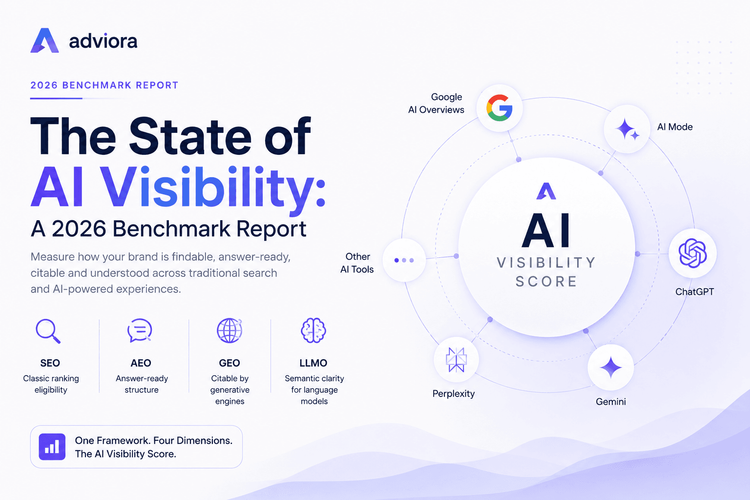
AI visibility is whether a brand is findable and citable across both classic search and the AI layer sitting on top of it — Google's AI Overviews and AI Mode, ChatGPT, Perplexity, Gemini and similar tools. In 2026 it is measured across four dimensions: SEO (classic ranking eligibility), AEO (answer-ready structure), GEO (citability by generative engines) and LLMO (semantic clarity for language models) — combined into a single AI Visibility Score. Traditional search volume is falling roughly on the pace Gartner predicted in 2024, AI Overviews have grown fastest in commercial-intent categories, and ChatGPT referral traffic more than tripled in 2025. Two schema types most teams still budget for — FAQPage and HowTo — are dead in Google Search. Closing the resulting gap is the subject of the rest of this report.

Vivek Kishore Verma

Gated download

How they are written

Five rules, applied to every paper

A white paper is only worth an hour of your time if you can check it. These are the rules that make that possible, and they are published before the papers rather than after.

  1. 01State the questionOne question per paper, written before any data is pulled, so the paper cannot quietly become an argument for whatever the data happened to show.
  2. 02Say where the data came fromThe source, the sample, the dates and the tooling. A number with no method behind it is an opinion in a serif font.
  3. 03Publish the limitsWhat the data cannot tell you, stated in the paper rather than left for a reader to discover. Every method has a boundary; hiding it is what makes a white paper marketing.
  4. 04Separate finding from recommendationWhat was observed, then - clearly marked as a different kind of claim - what we think you should do about it.
  5. 05Date it, and revise itAssistant behaviour changes quarterly. Each paper carries the date it was checked, and is revised or retired rather than left standing as though it were still true.

A paper that cannot meet these does not get published, which is why the shelf above is shorter than it could be.