
The State of AI Visibility: A 2026 Benchmark Report | Adviora
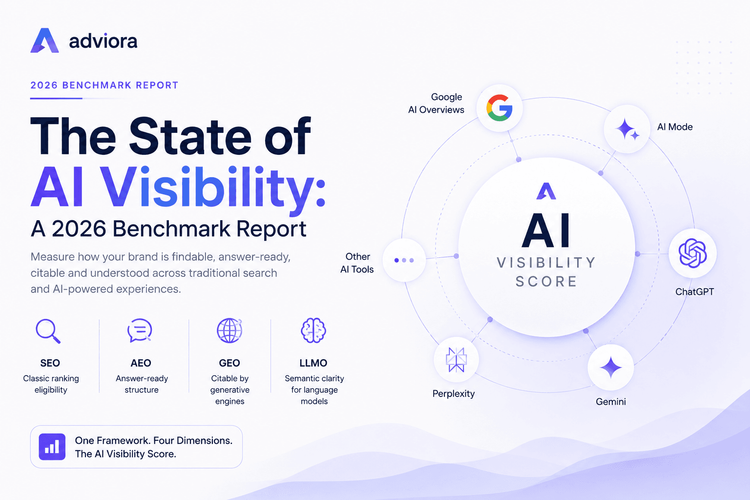
AI visibility is whether a brand is findable and citable across both classic search and the AI layer sitting on top of it — Google's AI Overviews and AI Mode, ChatGPT, Perplexity, Gemini and similar tools. In 2026 it is measured across four dimensions: SEO (classic ranking eligibility), AEO (answer-ready structure), GEO (citability by generative engines) and LLMO (semantic clarity for language models) — combined into a single AI Visibility Score. Traditional search volume is falling roughly on the pace Gartner predicted in 2024, AI Overviews have grown fastest in commercial-intent categories, and ChatGPT referral traffic more than tripled in 2025. Two schema types most teams still budget for — FAQPage and HowTo — are dead in Google Search. Closing the resulting gap is the subject of the rest of this report.
Published Aug 27, 2026Updated Aug 27, 2026
Quick answer
AI visibility is whether a brand is findable and citable across both classic search and the AI layer sitting on top of it — Google's AI Overviews and AI Mode, ChatGPT, Perplexity, Gemini and similar tools. In 2026 it is measured across four dimensions: SEO (classic ranking eligibility), AEO (answer-ready structure), GEO (citability by generative engines) and LLMO (semantic clarity for language models) — combined into a single AI Visibility Score. Traditional search volume is falling roughly on the pace Gartner predicted in 2024, AI Overviews have grown fastest in commercial-intent categories, and ChatGPT referral traffic more than tripled in 2025. Two schema types most teams still budget for — FAQPage and HowTo — are dead in Google Search. Closing the resulting gap is the subject of the rest of this report.
The State of AI Visibility: A 2026 Benchmark Report
What actually earns visibility once search stops being ten blue links-and what to do about it before the next benchmark cycle.
In February 2024, Gartner made a prediction that read, at the time, like an outer bound of a worst case: traditional search engine volume would drop 25% by 2026 as generative AI tools took over queries that used to run through a search box. That prediction is no longer a forecast. It's the operating environment. Google's own AI features now sit on top of an increasing share of commercial-intent queries, ChatGPT has become a referral channel with its own measurable revenue attribution, and two of the schema types most marketing teams were told to prioritise for a decade-FAQPage and HowTo-have been formally removed from Google Search altogether.
This report is Adviora's attempt to describe that environment plainly, using data we fetched and verified rather than data we assumed. It brings together market research from Gartner, Semrush, Ahrefs, chiefmartec.com, HubSpot, Salesforce and the CDP Institute, cross-referenced against Google's own current structured-data policy, into a single benchmark: what "AI visibility" actually means in 2026, how to score it across the four dimensions that make it up-SEO, AEO, GEO and LLMO-and what a site genuinely needs to have in place, schema included, to compete for it.
It's written for the person who now owns a problem that didn't have a clean name two years ago: keeping a brand visible across an answer layer that includes Google's AI Overviews and AI Mode, ChatGPT, Perplexity, Gemini and whatever the next entrant turns out to be-on top of, not instead of, classic search rankings. If that's your problem, this is the state of the market as of this quarter.
25% Predicted decline in traditional search volume by 2026 (Gartner, 2024) | 71% Growth in commercial-intent AI Overviews, Nov 2025–Apr 2026 (Semrush) | 206% ChatGPT outbound referral traffic growth in 2025 (Semrush clickstream data) | 4.4× Average AI-search visitor value vs. an average organic visitor (Semrush) |
Executive Summary
- Search is not being replaced; it's being layered. Gartner's 2024 prediction of a 25% drop in traditional search volume by 2026 was directional, not a claim that search disappears-and the market has moved almost exactly along that curve, with AI answer surfaces absorbing an increasing share of queries that used to generate a click.
- Growth is concentrated, not even. Semrush's July 2026 study found AI Overviews grew 71% across commercial-intent queries between November 2025 and April 2026, with finance (+231%) and computers & electronics (+108%) growing fastest-while transactional-intent AI Overviews actually declined 5% over the same window.
- AI referral traffic is now a measurable, valuable channel, not a rounding error. ChatGPT-driven outbound referral traffic grew 206% in 2025 (Semrush), and the average AI-search visitor is worth 4.4 times an average organic visitor by conversion value-with 86% of AI-platform referral visits attributable to ChatGPT alone as of mid-2025.
- Two of the schema types most 2021-era SEO checklists still recommend are inert. FAQPage rich results were restricted to a narrow set of government/health sites in 2023 and removed from Google Search entirely as of 7 May 2026; HowTo rich results have shown nothing since 2023.
- The gap isn't awareness, it's operationalization. As with martech generally-a 15,505-product landscape in 2026 that grew just 0.79% (chiefmartec.com)-most organizations already have the dashboards and the audits. What most of them lack is a single score that tells them what to fix first, which is the specific gap this report's scoring framework is built to close.
1. The Shift: Why "Ranking #1" Stopped Being the Finish Line
For two decades, the working assumption behind search marketing was simple: rank higher, get more clicks. That assumption is breaking, not because ranking stopped mattering, but because a growing share of queries now resolve inside an AI answer before a ranked list of links is even shown. Gartner named this directly in February 2024-Alan Antin, VP Analyst at Gartner, described generative AI tools as "becoming substitute answer engines, replacing user queries that previously may have been executed in traditional search engines"-and projected a 25% decline in traditional search engine volume by 2026 as a result.
- That 25% figure was a market-level prediction, not a per-brand guarantee-some categories are affected far more than others, and this report's data on commercial-intent growth (Section 2) shows exactly how unevenly.
- The shift shows up first in commercial and informational queries, where an AI Overview or chatbot answer can resolve the query without a click-which is precisely where Semrush's 2026 study found the fastest AI Overview growth.
- It does not eliminate the value of ranking well. Google's AI features are tied to the same indexing and snippet-eligibility bar as classic search results-a page still has to clear that bar before it's eligible to be cited inside an AI answer at all.
- It adds a second scoreboard on top of the first. A brand can rank #1 in classic search and still be functionally invisible inside the growing share of queries an AI system answers directly-which is the exact scenario this report calls the AI visibility gap.
2. Benchmark Data: How Fast the AI Layer Is Actually Growing
Three independent data sets, fetched directly from their publishers, describe the same shift from different angles: how often an AI answer appears, how much traffic it sends, and what that traffic is worth.
| Metric | Figure | Source & timeframe |
| Predicted decline in traditional search volume | 25% by 2026 | Gartner press release, 19 Feb 2024 |
| Growth in commercial-intent AI Overview appearances | +71% | Semrush study, Nov 2025 – Apr 2026 |
| Change in transactional-intent AI Overview appearances | −5% | Semrush study, same window |
| SERPs showing both Google Ads and AI Overviews together | +394% by end of 2025 | Semrush study, vs. prior-year baseline |
| Finance-sector commercial-intent AI Overview growth | +231.25% | Semrush study (fastest-growing sector measured) |
| ChatGPT outbound referral traffic growth | +206% in 2025 | Semrush 17-month clickstream analysis |
| Share of major-AI-platform referral visits from ChatGPT | 86% | Semrush, mid-2025 snapshot |
| Average AI-search visitor value vs. average organic visitor | 4.4× | Semrush, AI visibility ROI research, Jul 2026 |
| US consumers who purchased after researching with AI | ~50% | Semrush, Jul 2026 |
| Martech landscape size / YoY growth | 15,505 products / +0.79% | chiefmartec.com, May 2026 |
Read together, the pattern is consistent rather than contradictory: AI answer surfaces are growing fastest exactly where buying decisions get made (commercial intent, finance, electronics), the traffic they do send converts at a premium, and the martech industry has stopped adding net new capacity at the same time-which means the fix has to come from getting more out of what a stack already measures, not from adding another dashboard.
3. Why Structured Data Got Harder to Get Right, Not Easier
A predictable side effect of the shift toward AI answers was a wave of advice telling teams to add more schema markup, faster. Some of that advice is now actively wrong. Google has spent 2023 through 2026 narrowing which schema types earn anything in Google Search, while the underlying policy-markup has to match what a page actually shows-hasn't moved at all.
- FAQPage: restricted in 2023 to a narrow band of well-known government and health sites, then removed from Google Search entirely as of 7 May 2026. The markup is inert; it does no harm on old pages, but it earns nothing on new ones.
- HowTo: removed from Google Search in 2023, with the underlying documentation deleted by Google outright-a stronger signal than a quiet deprecation.
- Review / AggregateRating: still active, but explicitly void when the reviewed business controls the reviews about itself-the single most common way teams accidentally disqualify their own markup.
- Organization, BreadcrumbList and Article: still active and, if anything, more important than before-not because they win a rich result, but because they're part of the eligibility and disambiguation layer AI features and generative engines both lean on.
The net effect is that structured data has gotten harder to get right, not easier: fewer schema types reward effort, and the ones that remain are governed by stricter rules about what's genuinely visible and user-sourced. Section 6 turns this into a concrete requirements checklist.
4. The AI Visibility Scoring Framework
Adviora scores AI visibility as a composite of four sub-scores. Each one answers a different question about the same page or site, and a strong AI Visibility Score requires all four-a page that excels at one and neglects the others is optimizing for a scoreboard that no longer exists on its own.
| Sub-score | Question it answers | What raises it |
| SEO | Is this page eligible to rank in classic search at all? | Crawlability, indexing, Core Web Vitals, keyword targeting, internal linking, technical health. |
| AEO | Can an answer engine extract a direct answer from this page? | Answer-first structure, question-based headings, concise extractable steps, FAQ written as prose. |
| GEO | Would a generative engine cite this page in a synthesized answer? | Citable, well-sourced, structurally clean passages a model can lift without guessing. |
| LLMO | Does this page read unambiguously to a language model? | Consistent entity naming, explicit definitions, semantic clarity, no unresolved jargon. |
A page's AI Visibility Score is only as strong as its weakest sub-score. A technically flawless page (high SEO) that never states its own conclusions plainly (low AEO) is exactly as invisible to an AI Overview as a well-written page (high AEO) that's blocked in robots.txt (zero SEO). The framework is deliberately additive for this reason-it's meant to surface the specific dimension that's holding a page back, not produce one blended number that hides which lever to pull.
5. Where This Actually Shows Up: A Worked Example
Two pieces from Adviora's own Knowledge Hub illustrate the framework in practice rather than in the abstract.
A technical SEO checklist built around crawlability, indexing and Core Web Vitals raises the SEO sub-score specifically-it doesn't touch AEO or GEO at all, because eligibility to rank and readiness to be cited are different problems solved by different work. Separately, a practical guide to schema markup and structured data raises GEO and LLMO by removing dead FAQPage/HowTo reliance and tightening Organization and Article markup-the exact requirements restated in Section 6 below.
Neither piece tries to move all four sub-scores at once, and that's the point: a benchmark report is only useful if it tells a team which sub-score to fix first, not just that something, generally, could be better.
Where does your own AI Visibility Score actually stand? Adviora's audit scores a site across SEO, AEO, GEO and LLMO individually, then rolls the four into a single AI Visibility Score-with a Priority Action Checklist attached to whichever sub-score is weakest, not just a number. |
6. Requirements Checklist: SEO, AEO, GEO, AI Visibility Score and Schema
This is the working checklist behind the framework in Section 4-the specific, current requirements each sub-score and the schema layer underneath it depend on, as of this report's publication date.
SEO requirements
- Page is crawlable and indexable: no unintended robots.txt disallow, no accidental noindex, confirmed in Search Console.
- Core Web Vitals pass on field data (75th percentile, Chrome UX Report), not only a lab score-LCP, INP and CLS thresholds specifically.
- Primary keyword present in the title tag, H1, intro paragraph and at least one subheading, without keyword stuffing.
- Clean internal linking to and from topically related pages, with descriptive (not "click here") anchor text.
- Canonical URL set; page included in the XML sitemap and the site's information architecture.
AEO requirements
- A quick-answer paragraph near the top that could stand alone if lifted directly into an answer box.
- Headings phrased as the questions a user would actually type or ask, not generic section labels.
- Numbered, extractable steps for any process-written as a self-contained ordered list, not buried in prose.
- FAQ content written as clear, visible prose (schema for it is optional and, per Section 3, should not be FAQPage).
GEO requirements
- Every non-obvious claim traceable to a specific, named, dated source-not a vague "studies show."
- Passages structured so a generative engine can lift them without paraphrase risk: precise numbers, clear attribution, no ambiguous pronouns.
- No invented statistics. A genuinely missing figure should be flagged as missing rather than estimated.
- Content that matches what's visible on the rendered page-nothing a crawler sees that a human visitor doesn't.
AI Visibility Score (composite)
- All four sub-scores (SEO, AEO, GEO, LLMO) measured individually before being combined-never averaged without visibility into which one is weakest.
- Re-benchmarked on a fixed cadence (Adviora recommends quarterly) given how quickly AI Overview coverage and schema policy have both moved in 2025–2026 alone.
- Tracked alongside classic ranking position, not instead of it-the two scoreboards move somewhat independently, per Section 1.
Schema requirements
- Do not add new FAQPage or HowTo JSON-LD. Both are inert in Google Search-FAQPage removed 7 May 2026, HowTo removed 2023-and effort spent there earns nothing.
- Add Organization schema at the site level: name, logo (minimum 112×112px), url and sameAs profiles, using the exact brand name shown in title tags.
- Add BreadcrumbList to every template with a navigational hierarchy deeper than one level.
- If using Review or AggregateRating markup, confirm reviews are sourced directly from users and are not about a listing the business itself controls-self-serving review markup is explicitly ineligible.
- Validate every remaining schema type in the Rich Results Test before, not after, a template deploy, and monitor the Rich Result Status report in Search Console monthly.
7. Closing the Gap: From Benchmark to Action
A benchmark score is diagnostic, not corrective. Knowing a site sits at 61/100 on GEO doesn't, by itself, fix anything-which is the same insight-to-action problem that shows up across marketing stacks generally: more measurement without a named owner, a deadline and a next step doesn't close a gap, it just documents it more precisely.
- Attach an owner and a deadline to the weakest sub-score first, rather than trying to move all four simultaneously.
- Re-run the Section 6 checklist against the client's or brand's own top templates as a month-zero baseline.
- Track time-to-action on flagged issues alongside the score itself-a score that never moves quarter over quarter usually means nobody owns fixing it.
- Treat this report's benchmark figures as a snapshot, not a constant: AI Overview coverage and referral value both moved measurably within the twelve months this report covers, and the next twelve are unlikely to move slower.
Conclusion
The data in this report tells one consistent story from three different angles: search hasn't disappeared, but a growing share of it now resolves inside an AI answer before a ranked list ever loads, that share is growing fastest in exactly the categories where money changes hands, and the schema advice most teams are still following is out of date by two to three years. None of that is cause for panic. It is, specifically, a measurement and prioritization problem - which is why this report ties every finding to a scoring framework and every score to a checklist, rather than leaving either as an abstraction. Benchmark where you stand, fix the weakest dimension first, and re-run the benchmark before assuming the fix held.
Related resources on the Adviora Knowledge Hub
Internal links, verified live against adviora.ai on 21 Aug 2026, plus this hub's two most recent companion pieces:
- Technical SEO Audit: Crawl, Index, Mobile, Performance - https://adviora.ai/knowledge-hub/technical-seo-audit-anatomy
- robots.txt for AI Crawlers: GPTBot, ClaudeBot & More - https://adviora.ai/knowledge-hub/ai-crawler-access-audit-robots-txt
- How to Get Cited by ChatGPT, Claude & Perplexity - https://adviora.ai/knowledge-hub/how-to-get-cited-by-ai-search
- E-E-A-T Explained: Google's 4 Quality Signals Decoded - https://adviora.ai/knowledge-hub/eeat-explained-checklist
- Modern Search Metrics Glossary: AEO, GEO and AI Scores - https://adviora.ai/knowledge-hub/modern-search-metrics-glossary
- How SEO, GEO and AEO Actually Differ - https://adviora.ai/knowledge-hub/seo-vs-geo-vs-aeo-explained
- Zero-Click Search: Why Ranking #1 Isn't Being Found - https://adviora.ai/knowledge-hub/zero-click-search-ai-answers
- The 7 Trust Pages Every Website Must Have - https://adviora.ai/knowledge-hub/trust-pages-every-website-needs
- Technical SEO Intelligence (feature) - https://adviora.ai/technical-seo
- Website Audit (feature) - https://adviora.ai/website-audit
- Book a demo - https://adviora.ai/contact
From this same content series (companion articles, referenced above in the body copy):
- Technical SEO Checklist: Crawlability, Indexing, and Core Web Vitals - https://adviora.ai/knowledge-hub/technical-seo-checklist-crawlability-indexing-core-web-vitals
- What Still Works in Schema Markup: A Practical Guide to Structured Data for AI Discoverability - https://adviora.ai/knowledge-hub/schema-markup-structured-data-ai-discoverability
- Why "Insight to Action" Is the Missing Link in Most Marketing Stacks - https://adviora.ai/knowledge-hub/insight-to-action-gap-marketing-stacks
Primary and industry sources cited in this report (external links, fetched and verified live on 21 Aug 2026):
- Gartner - "Gartner Predicts Search Engine Volume Will Drop 25% by 2026 Due to AI Chatbots and Other Virtual Agents" (19 Feb 2024) - https://www.gartner.com/en/newsroom/press-releases/2024-02-19-gartner-predicts-search-engine-volume-will-drop-25-percent-by-2026-due-to-ai-chatbots-and-other-virtual-agents
- Semrush - "AI Overviews are expanding across commercial intent search" [Study] - https://www.semrush.com/blog/ai-overviews-commercial-search-study/
- Semrush - "How to determine AI visibility ROI and revenue impact" - https://www.semrush.com/blog/ai-visibility-roi/
- Semrush - "How to track ChatGPT traffic for you and for competitors" - https://www.semrush.com/blog/track-chatgpt-traffic-and-competitors/
- Ahrefs - "How Ahrefs Approaches the Challenge of Estimating AI Search Demand" - https://ahrefs.com/blog/how-ahrefs-estimates-ai-search-demand/
- chiefmartec.com - 2026 Marketing Technology Landscape Supergraphic: "Peak Martech Achieved! (Maybe)" - https://chiefmartec.com/2026/05/2026-marketing-technology-landscape-supergraphic-peak-martech-achieved-maybe/
- Google Search Central - FAQ (FAQPage) structured data - https://developers.google.com/search/docs/appearance/structured-data/faqpage
- Google Search Central - HowTo structured data (removed) - https://developers.google.com/search/docs/appearance/structured-data/how-to
- Google Search Central - Review snippet (Review, AggregateRating) - https://developers.google.com/search/docs/appearance/structured-data/review-snippet
- Google Search Central - Organization structured data - https://developers.google.com/search/docs/appearance/structured-data/organization
- Google Search Central - AI features in Google Search - https://developers.google.com/search/docs/appearance/ai-features
- CDP Institute - industry data, definitions and 2025 member survey findings - https://www.cdpinstitute.org/
| Type | Technical SEO |
|---|---|
| Published | Aug 27, 2026 |
| Updated | Aug 27, 2026 |
Frequently asked questions
It's a composite score combining SEO, AEO, GEO, and LLMO to measure how easily a brand is found and cited across search engines and AI platforms.
A February 2024 forecast for 2026, with this report's data broadly supporting the trend, though the decline varies by category rather than occurring uniformly.
No. FAQPage rich results were restricted to a narrow set of sites in 2023 and removed from Google Search entirely as of 7 May 2026. HowTo has been inert since 2023. Neither produces a visible result in Google Search any more.
No. SEO measures eligibility to rank in classic search. AEO, GEO and LLMO measure whether an AI system can extract, cite and correctly interpret the page once it's eligible. All four move somewhat independently.
Run quarterly at minimum, and after every migration, template change, or major schema update, as AI search and structured-data policies continue to evolve.
Ready to see which layer is actually failing?
Adviora's GEO & AEO Visibility module scores your AEO, GEO and AI Visibility Index separately, and audits AI crawler access agent by agent