AEO vs SEO: A Beginner's Guide to Winning AI Search in 2026
Search changed the moment AI-generated answers stopped being a novelty and became the default. Buyers who once scanned ten blue links now get a single synthesized answer from ChatGPT, Google AI Overviews, or Perplexity - and if your content isn't the source behind that answer, you don't just rank lower, you disappear from the conversation entirely. Choosing how to structure your content strategy is no longer a nice-to-have - it decides whether your brand shows up in the moment a buyer is actually deciding.
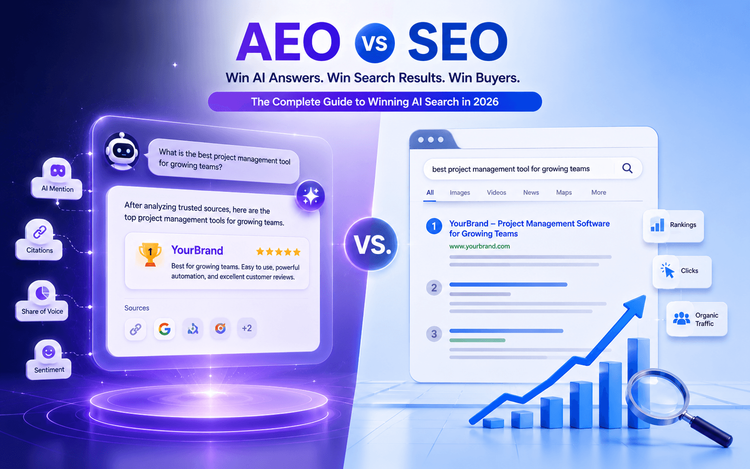
This guide compares two disciplines: traditional SEO, the established practice of ranking on a results page, and Answer Engine Optimization (AEO), the newer practice of getting selected as the source inside an AI-generated answer.
The Two Disciplines
SEO (Search Engine Optimization) is the established practice of earning a position on a search results page - the one a human then has to click. It runs on backlinks, technical health, keyword targeting, and page authority, and it has driven digital marketing for two decades.
AEO (Answer Engine Optimization) is the practice of structuring content so AI-powered answer engines - ChatGPT, Perplexity, Google AI Overviews, Gemini, Copilot, and voice assistants - select it as a trustworthy source to cite, quote, or recommend directly inside a generated answer, before the person ever sees a page of links.
In short: SEO ranks pages. AEO gets selected as a source. This shift is no longer a fringe behavior - Google's own AI Overviews had reportedly reached roughly 1.5 billion monthly users following its expansion around Google I/O 2025.¹ Whatever the exact current figure, the direction is clear: this is becoming the default search habit, not an edge case.
Why AI Search Is Harder to Win Than Traditional SEO
The uncomfortable truth for most SEO teams: the playbook that got you ranked on page one doesn't reliably get you cited in the answer above it. Ranking position and AI citation are correlated but no longer tightly coupled - a #1 Google ranking no longer reliably means you'll also be the source an AI system cites.² A strategy that can't account for this shift can't win the moment that matters most: the one before the click, if there's a click at all.
What's changed underneath the surface:
- Zero-click search is now the majority behavior. SparkToro's long-running zero-click research puts the share of U.S. Google searches ending without a click at roughly 58–60% in its most recent widely-cited figures - the answer is delivered directly, and the searcher never visits a website.³
- AI Overviews show up often, and growing. AI-generated answer summaries now appear across a large and expanding share of Google search results, per BrightEdge's tracking of the rollout.⁴
- Ranking position is losing predictive power. Being the top organic result is no longer a reliable proxy for being the source an AI system chooses to cite.
- Voice search is AEO in its purest form, even though the "what share of searches are voice" statistic has a messy history in this industry - several widely-repeated voice-search percentages over the years have turned out to be unsourced or outdated.⁵ The safer, structural claim: a spoken answer only has room for one source, so it's either 100% share of voice or zero - the exact binary outcome AEO is built to win.
The Citation Signal Framework: What AI Systems Actually Reward
Rather than chasing rankings alone, AI systems pull from a different set of signals. The clearest evidence on this comes from a controlled, academic study - commonly referred to as "GEO: Generative Engine Optimization," from researchers affiliated with Princeton, Georgia Tech, and the Allen Institute for AI - which tested content-optimization techniques across a large query set and found specific, measurable levers that moved a page's share of the AI-generated answer.⁶ Distilled into four signals worth optimizing for, in order of evidence strength:
- Quotability - adding direct quotations from credible sources produced a meaningful, measurable lift in visibility in the controlled study above.
- Statistical grounding - adding relevant, specific statistics also produced a measurable improvement.
- Citation of authority - referencing authoritative external sources improved visibility as well.
- Freshness - content addressing commercial and evaluation-stage queries appears to draw more AI citations when recently updated rather than left stale.⁷
*(The specific per-technique percentages sometimes quoted for the academic study above - e.g., precise figures for quotations vs. statistics vs. citations individually - should be checked against the published paper directly before being restated as exact numbers on the live page. The direction and general magnitude of the finding is well-supported; exact sub-figures deserve a page-level citation check before publishing.)*
Feature Comparison at a Glance
For the technical foundation behind traditional search visibility, explore Adviora's Technical SEO Intelligence
| Capability | Traditional SEO | AEO (Answer Engine Optimization) |
| Primary goal | Rank on the results page | Get selected as the cited source inside the answer |
| Success metric | Position, clicks, CTR | Citation rate inside AI-generated answers |
| Content structure | Keyword-targeted long-form pages | Question-shaped headings, answer-first formatting |
| Authority signals | Backlinks, domain authority | Backlinks *and* brand mentions - several industry analyses suggest mentions correlate more strongly with AI citation than backlinks alone⁸ |
| Freshness requirement | Periodic updates | Higher - commercial-intent AI citations skew toward recently updated pages⁷ |
| Structured data | Helpful, not critical | Core requirement - FAQ, HowTo, and Organization schema make content machine-readable |
| Voice search coverage | Minimal | Direct - AEO is the only discipline built for single-answer voice queries |
| Measurement | Rank tracking, organic traffic | Citation frequency, AI mention tracking, share of AI-generated answer |
The pattern is clear: traditional SEO still wins on breadth and established infrastructure, while AEO wins on the specific mechanics that determine whether AI systems cite you at all. Most teams don't need to pick one - they need both, connected.
What Strong AEO Actually Does
Judge a content strategy against the same four-signal framework above, applied practically:
- Structures content around direct questions - question-shaped H2s that mirror how buyers actually ask AI assistants things, with the answer delivered in the first 1–3 sentences.
- Backs claims with citable specifics - real statistics, named sources, and direct quotes, since this is the most research-backed lever for AI citation currently available.
- Stays current - treats high-intent commercial pages as living documents given how strongly freshness appears to predict citation.
- Standardizes entity information - brand, product names, and category positioning described identically across the site, schema markup, and third-party listings.
- Earns mentions, not just links - digital PR and third-party coverage alongside traditional link building, given the apparent relationship between brand mentions and AI citation.
Why Freshness and Citations Matter Most
AI systems have a catch: they can only cite what's clear, current, and verifiable. A page with vague claims and no supporting data gets skipped in favor of a competitor's page with a named statistic and a recent update - and nothing costs a brand visibility faster than being technically accurate but functionally uncitable. The fix is a documented, evidence-first content model: real data, named sources, and a visible update cadence that gives an AI system a reason to trust the page enough to quote it. That turns AEO from a theory into something measurable - protecting both the brand's visibility and its credibility when it does get cited. It's also, not coincidentally, the exact standard this document holds itself to - see the sourcing notes in the optimization report below.
Best Fit by Use Case
For brands with an established SEO foundation looking to extend into AI-search visibility, layering AEO onto existing high-authority pages is the fastest path - structure and citations first, new content second. For newer brands or category challengers, AEO can be a genuine first-mover advantage: industry surveys suggest a meaningful gap between how many marketers believe AEO will matter soon and how many have actually started implementing it⁹ - so the competitive bar is still low in most categories. Traditional SEO alone remains the stronger sole focus only where AI-generated answers haven't yet meaningfully entered a buyer's research journey - a shrinking set of categories as AI Overviews expand their reach.