The AI Visibility Audit: 15 Questions Every Marketing Leader Should Ask
A well-reported field audit from AI-visibility firm IQRush, published via Search Engine Journal in October 2025, found that fewer than one in ten AI-generated answers included the brand being tested for — even though four out of five of the mentions that did occur were backed by a real citation.¹ Read together, those two numbers say something specific: when AI systems do decide to mention a brand, they tend to back it up with a source. The problem for most companies isn't citation quality. It's that they're not in the conversation at all.
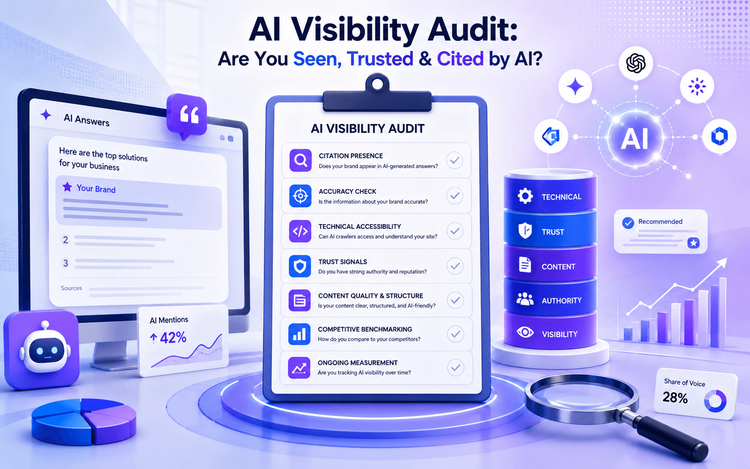
That's the gap an AI visibility audit is built to find. This is a companion piece to our step-by-step audit guide — same underlying goal, organized instead as 15 direct questions you can put to your own marketing team this quarter, mapped to the same seven audit layers Adviora's own engines run automatically.
Question 1: Does Your Brand Actually Show Up in AI-Generated Answers?
Audit it: Take 15–20 real customer questions and run each one through ChatGPT, Gemini, Claude, and Perplexity in a fresh session. Log whether your brand is mentioned at all.
Why it matters: This is your baseline Share of Model — the percentage of tested queries where an AI assistant's answer mentions your brand. Everything else in this audit exists to move this one number.
Question 2: Can Every Claim on Your Priority Pages Be Traced to a Source?
Audit it: Pull your 10 highest-traffic or highest-intent pages. For every factual claim — a statistic, a certification, a "leading" or "best" statement — check whether it links to or names a verifiable source.
Why it matters: AI systems increasingly weight verifiable claims over marketing language. An unsupported claim isn't just a legal risk; it's a page an AI system has less reason to trust and cite.
Question 3: Does Your Content Match How People Actually Talk to AI Assistants?
Audit it: Compare your existing content's phrasing against the conversational, full-sentence way people query ChatGPT or Perplexity, versus the fragment-style way they type into Google. Rewrite a sample page's headers as direct questions and see how differently it reads.
Why it matters: Content built purely around keyword fragments often fails to match the semantic shape of a conversational query, even when the underlying topic is the same.
Question 4: Is Your Product or Service Data Actually Machine-Readable?
Audit it: Check whether your priority pages carry complete, valid schema markup — Product, Service, Organization, FAQPage — and test a transactional query to see whether pricing and availability information surfaces correctly.
Why it matters: An AI system parsing your page for a direct answer needs structured data to extract from; prose alone is a much weaker signal for this specific purpose.
Question 5: Does Your Content Show Real Freshness Signals?
Audit it: Check your top pages for a visible, genuine last-updated date, and confirm the statistics and references inside are still current rather than several years stale.
Why it matters: Freshness is one of the more consistently cited factors in what makes AI systems prefer one source over another for time-sensitive topics.
Question 6: Do Your Dashboards Actually Track AI Visibility — or Just Organic Rankings?
Audit it: Open your current marketing dashboard. Is there a single metric on it related to AI citation, mention frequency, or Share of Model? If not, that's the gap.
Why it matters: You can't manage what you don't measure, and most marketing reporting stacks were built entirely around Google Analytics and Search Console — neither of which shows AI citation activity.
Question 7: Where in the Funnel Are You Actually Invisible?
Audit it: Bucket your Question 1 test queries by funnel stage — awareness, consideration, decision — and calculate a visibility rate for each bucket separately, not just an overall average.
Why it matters: A brand can look fine on an aggregate Share of Model number while being completely invisible at the exact stage — usually consideration, where comparisons happen — that matters most for revenue.
Question 8: Are You Accidentally Blocking the AI Crawlers You Want to Be Found By?
Audit it: Check your robots.txt for disallow rules that block GPTBot, Google-Extended, ClaudeBot, or PerplexityBot, deliberately or by an old overly broad rule.
Why it matters: No amount of content quality matters if the crawler can't reach the page in the first place — this is a five-minute check with an outsized downside if it's wrong.
Question 9: How Do Your Trust Signals Compare to the Brands That Are Getting Cited?
Audit it: Pick the three competitors who won the most citations in your Question 1 test. Compare their author bylines, About pages, and outbound citations against your own.
Why it matters: Trust signals are relative, not absolute — knowing the gap between you and whoever's actually winning the citation tells you exactly what to close first.
Question 10: Are Your Backlinks Reinforcing or Undermining Your Authority?
Audit it: Run a referring-domain quality check, not just a raw backlink count — a smaller number of high-authority, relevant links beats a large number of low-quality ones for the trust signal AI systems appear to weight.
Why it matters: Domain authority still feeds into how credible a source looks, to both traditional search algorithms and the training and retrieval processes behind AI-generated answers.
Question 11: Which of Your Buyer Segments Is Most Invisible?
Audit it: Re-run Question 1's test queries, but segmented by the specific customer persona each question represents, not just by topic. Look for a persona with a visibility rate meaningfully lower than the others.
Why it matters: Aggregate visibility numbers can hide a segment-level blind spot — the persona least represented in your content is very likely the persona least represented in AI answers about you.
Question 12: Does Your Own Company Knowledge Base Actually Explain Who You Are?
Audit it: Read your About page, product pages, and press mentions as if you were an AI system trying to build a factual summary of your company from scratch. Is the picture complete, current, and consistent across pages?
Why it matters: AI systems synthesize an understanding of a brand from whatever's publicly available; gaps, contradictions, or stale information in your own foundational pages directly limit how accurately — or how often — you can be described.
Question 13: When You Are Mentioned, Is the Information Actually Accurate?
Audit it: For every AI mention found in Question 1, rate it: fully accurate, partially accurate, or wrong. Don't just count mentions — grade them.
Why it matters: An AI system confidently stating outdated pricing, a discontinued feature, or the wrong category for your business is arguably worse than no mention at all, since it actively misinforms a prospective customer.
Question 14: Do Your Pages Hold Up When Someone Actually Clicks Through From an AI Answer?
Audit it: Check load speed, mobile rendering, and message match for the specific pages that got cited in Question 1 — the exact pages a curious reader would land on.
Why it matters: A citation is only valuable if the page behind it converts; a slow or mismatched landing experience wastes the exact visibility this whole audit is trying to earn.
Question 15: Is This a Repeatable Process, or a One-Time Report?
Audit it: Put a date on your calendar right now to re-run Questions 1, 7, 11, and 13 next quarter, using the same test queries so the trend is comparable.
Why it matters: AI-generated answers shift far more often than organic rankings do. A single audit is a snapshot; a quarterly rerun is the only version of this that actually compounds.