50 ChatGPT Prompts for SEO, GEO & AI Visibility
Generic "ChatGPT prompts" megalists have become their own content genre — some run to 200-plus prompts spanning email marketing, social media, sales, and a dozen other functions in one giant scroll. Useful as a reference shelf, less useful when what you actually need is 20 minutes to fix a technical SEO gap, rewrite a page so an AI assistant will actually quote it, or figure out why a competitor keeps getting cited instead of you.
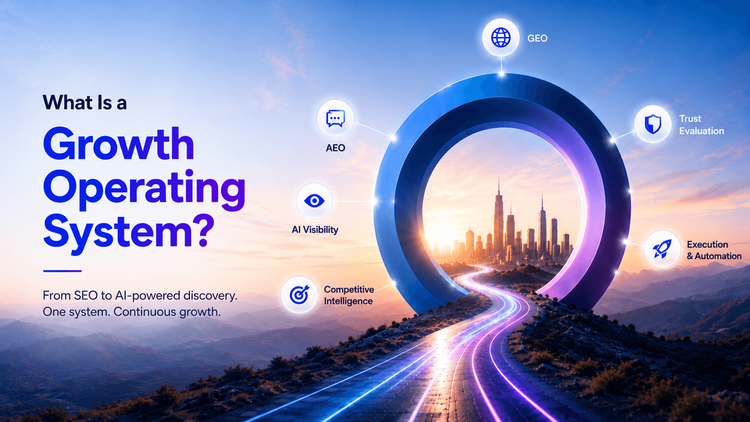
This is a narrower, deeper list: 50 prompts, organized around the six things that actually move the needle on SEO, GEO, AEO, and overall AI visibility — the same six areas Adviora's own audit engines are built to cover. Copy, fill in the brackets, and adjust the output to your own voice.
Why Generic Prompt Lists Fall Short for SEO and AI Visibility Work
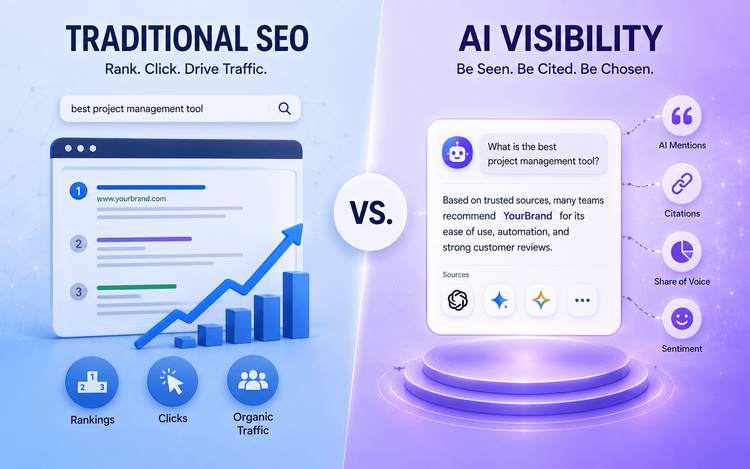
Most ChatGPT prompt roundups are built for breadth — one prompt for a LinkedIn post, one for a cold email, one for a product description — because the audience is "marketers in general." That's a legitimate use case, but it means SEO, GEO, and AEO usually get a handful of prompts buried among dozens of unrelated categories, if they're covered at all.
The work of improving AI visibility specifically has its own shape: you're not just writing content, you're diagnosing why an AI assistant didn't cite you, rewriting a paragraph to be more quotable, drafting FAQ schema, or auditing whether your trust signals hold up. Those are different tasks with different prompt structures than "write me a tweet," and they deserve their own list.
The Adviora Prompt Blueprint
Before the prompts themselves, a quick structure worth reusing for anything not covered below. Every effective SEO/GEO prompt has four parts:
| Part | What it does | Example |
| Context | What ChatGPT needs to know about your business, page, or situation | "I run a B2B project management SaaS targeting agencies with 10–50 employees." |
| Objective | The specific, single task — not "help with SEO," but the exact deliverable | "Rewrite this paragraph so it directly answers the question in the first sentence." |
| Format | How you want the output structured | "Return it as a table with columns for Issue, Why It Matters, and Fix." |
| Guardrails | Explicit limits — especially anti-hallucination instructions | "Do not invent statistics or cite studies you cannot name a real source for. Flag anything you're unsure of instead of guessing." |
Every prompt in this library follows that shape. When you need a prompt that isn't here, build it the same way.
Technical SEO Audit Prompts
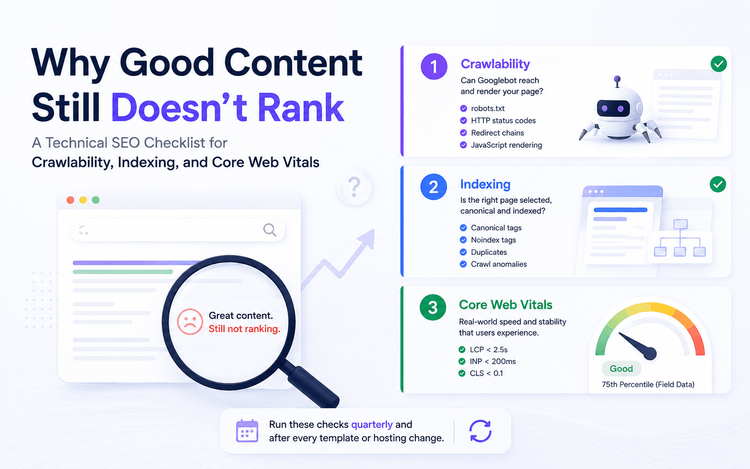
- "Act as a technical SEO auditor. Given this list of URLs and their status codes [paste], flag anything that looks like a crawl or indexation problem and explain why."
- "Review this robots.txt file [paste] and tell me which AI crawlers (GPTBot, Google-Extended, ClaudeBot, PerplexityBot) would be blocked by it, if any."
- "I'm going to paste my XML sitemap structure [paste]. Identify any obvious gaps — missing page types, outdated lastmod dates, or orphaned sections."
- "Explain, in plain language for a non-technical stakeholder, why Core Web Vitals matter for both traditional SEO and AI-generated answers that link back to source pages."
- "Given this page's current title tag, meta description, and H1 [paste], suggest three alternative title tags, each using a different click-psychology angle (curiosity, specificity, urgency)."
- "Review this canonical tag setup across these five URLs [paste] and flag any duplicate-content risk."
- "Draft a plain-English internal linking checklist I can hand to a content writer with no SEO background."
- "I'm auditing schema markup on this page [paste the JSON-LD]. Confirm the schema type is valid and flag any required fields that are missing — but tell me plainly if you're not fully certain, rather than guessing."
E-E-A-T & Trust Signal Prompts
- "Draft an author bio template for a YMYL-adjacent health content site that highlights genuine credentials without overstating expertise."
- "Review this About page copy [paste] and tell me what's missing compared to what a trust-conscious reader — or an AI system evaluating credibility — would expect to see."
- "Suggest five outbound citation opportunities I should add to this article on [topic] to support its main claims with credible primary sources — but don't invent source names; tell me the type of source to look for instead."
- "Draft a short editorial policy page explaining how we fact-check and update our content."
- "Given this list of trust signals [paste: author bios, citations, certifications, etc.], rank which ones are most commonly missing on B2B SaaS sites and why that matters for AI-generated answers."
- "Write Person schema markup for this author bio [paste], structured correctly for connecting the author to their expertise."
GEO & AI Citation Prompts
- "Rewrite this paragraph [paste] so its first sentence is a clear, self-contained, quotable answer to the question '[insert question]' — the kind of sentence an AI assistant could lift directly."
- "I'm going to give you a claim from my content [paste]. Tell me whether it reads as a vague qualitative statement or a specific, grounded claim, and suggest how to make it more specific without inventing a number I don't have."
- "Draft 10 real questions a prospective customer for [business type] might ask ChatGPT, Gemini, Claude, or Perplexity that our content should be positioned to answer."
- "Given this page [paste], suggest where adding a named source or citation would most strengthen its authority signal, without fabricating a source."
- "Explain the difference between GEO (Generative Engine Optimization) and AEO (Answer Engine Optimization) in two sentences a non-marketer would understand."
- "Draft an llms.txt file structure for a site with these key page categories [paste]."
- "Review this content's 'last updated' visibility and freshness signals and suggest what to add to make it clearer to both readers and AI crawlers."
- "I ran a manual Share of Model test and my brand wasn't mentioned in [X] of [Y] test queries. Help me draft a prioritized list of hypotheses for why, based on this content I'm about to paste."
AEO & Featured Snippet Prompts
- "Generate 8 FAQ questions and concise answers for a page about [topic], each answer under 50 words and structured for featured snippet eligibility."
- "Write FAQPage JSON-LD schema for these 5 questions and answers [paste]."
- "Review this paragraph and tell me whether it's structured to win a Google featured snippet — and if not, restructure it so the direct answer comes first."
- "Draft 5 'People Also Ask'-style questions our target audience is likely searching for around [topic], based on how real buyers phrase problems, not just keyword variations."
- "Turn this list of product features [paste] into a conversational FAQ format matched to how a voice-search query would be phrased."
Content Citability & Rewrite Prompts
- "Take this paragraph [paste] and rewrite it using the four-part Citation Signal Framework: make the opening sentence quotable, add a place for a specific data point (mark it as [STAT NEEDED] rather than inventing one), reference where a citation could go, and flag if it needs a freshness update."
- "Summarize this 2,000-word article into a 100-word 'quick answer' block suitable for the top of the page."
- "Rewrite this technical explanation for a reader with no industry background, without losing the specific detail that makes it credible."
- "Given this outdated blog post [paste], list exactly what needs to be updated to make the content current again, without rewriting anything I haven't flagged as outdated."
- "Turn these five bullet points [paste] into a short, structured comparison table."
- "Draft three different opening paragraphs for an article on [topic], each using a different hook (a question, a statistic placeholder, a direct claim)."
Competitor & Market Research Prompts
- "Based on publicly available information you're confident about, describe the general positioning differences between [Category A tools] and [Category B tools] — and explicitly flag anything you're not fully certain is still accurate."
- "Draft a neutral, three-column comparison table structure (Feature, Us, Competitor) that I can fill in myself with verified information — don't populate the competitor's specific claims for me."
- "Help me draft interview questions for a customer to understand why they chose a competitor's product over ours."
- "Suggest five content gaps we might have compared to competitors in the [industry] space, based on common topics in that category — flagged as hypotheses to verify, not confirmed gaps."
How to Verify What ChatGPT Tells You
Every prompt above that touches a factual claim — a statistic, a competitor's feature, a source citation — includes an instruction not to guess. That's not boilerplate caution; it's a load-bearing part of using ChatGPT for this kind of work responsibly. Large language models are well known to occasionally generate plausible-sounding but incorrect information, especially around precise numbers, dates, and claims about specific named organizations. Before publishing anything ChatGPT drafted that includes a statistic, a competitor claim, or an attributed source, verify it against a primary source yourself — the same discipline this content series has applied to its own statistics throughout, flagging anything not independently re-confirmed.