AI Visibility vs. Traditional SEO: What's the Real Difference?
Search is no longer confined to a results page. Buyers now discover brands through some mix of Google Search, Google AI Overviews, ChatGPT, Gemini, Claude, and Perplexity — and that shift has created a new discipline usually called AI Visibility, AI SEO, Generative Engine Optimization (GEO), or Answer Engine Optimization (AEO), depending on who's writing about it.
These terms get pitched as replacements for SEO. They aren't. AI Visibility is an extension of search optimization, not a substitute for it — the goal shifts from ranking a URL to being accurately represented inside a model's answer. Traditional SEO still gets your website found; AI Visibility gets your brand cited and recommended. Both matter, and for the foreseeable future, neither one covers for the other.
The Core Definition Split
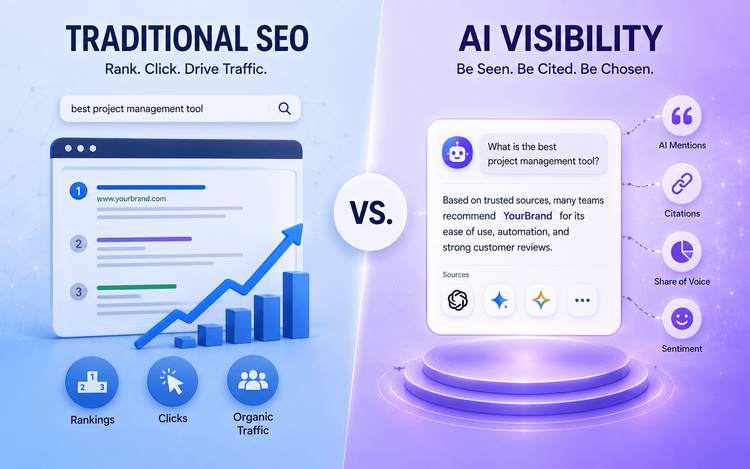
Traditional SEO improves a website's visibility in search engine results pages: where you rank, how many people click, how much traffic that ranking sends. It's measured in position, click-through rate, and sessions.
AI Visibility improves the odds your content gets pulled into an AI-generated answer in the first place — a ChatGPT response, a Gemini answer, a Google AI Overview. It's measured in mentions, citations, share of voice, and whether the model represents your brand accurately when it does mention you. Worth clarifying up front: GEO and AEO are, in current industry usage, largely interchangeable terms for this same discipline — some writers split AEO as the older practice of winning snippets/PAA boxes and GEO as the newer practice of winning citations inside generative answers, but most vendors and practitioners use the two terms to describe the same underlying job.
Why Both Still Matter — This Isn't Either/Or
Google still handles roughly 5 trillion searches a year — not a market in retreat. At the same time, Semrush's own research projects that LLM-driven traffic could overtake traditional organic search traffic by 2028. (Source: Semrush Blog, "Traditional SEO vs. AI SEO" — recommend confirming the exact figure and methodology in the live article before quoting it directly.) Both facts are true simultaneously, which is the actual state of the market: a massive, still-dominant channel, and a smaller, fast-growing one on a trajectory to eventually catch up. The practical takeaway is not to pick a side — optimize for both surfaces, because the traffic and trust each one carries doesn't fully overlap.
From Keywords to Conversations: What Actually Changes
The underlying skills transfer more than people expect, but almost every SEO task gets a real twist once AI Visibility enters the picture.
| SEO task | Traditional approach | AI Visibility approach |
| Discovery | Keyword research — volume, difficulty, intent | Prompt/topic mapping — AI prompts run roughly twice as many words as typical search keywords |
| On-page optimization | Keyword placement, headers, density | Self-contained, directly-answering sections a model can extract without surrounding context |
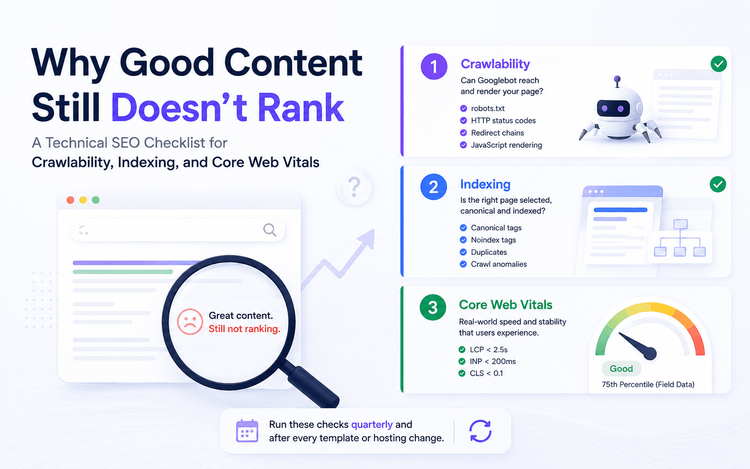
| Technical foundation | Crawlability, sitemaps, Core Web Vitals | All of that, plus confirming AI crawlers aren't blocked in robots.txt — most don't render JavaScript-heavy pages |
| Authority building | Backlinks from other sites | Earned brand mentions on review sites, forums, and publications — counted even without a clickable link |
| Measurement | Rankings, CTR, organic traffic | AI mentions, citation frequency, share of voice, sentiment |
The technical point is the one most teams haven't audited yet: a site can be perfectly indexable to Googlebot and still be functionally invisible to an AI crawler — either explicitly disallowed in a robots.txt rule nobody's revisited, or rendered client-side in JavaScript the crawler never executes. Both are one-line fixes once you know to look.
The "Library vs. Conversation" Mindset
Classic SEO treated the web like a library: publish a page, get indexed, get found when someone searches the right term. It's a static, catalog relationship between content and searcher.
AI search behaves more like an ongoing conversation. Someone asks a question, follows up, compares options, adds a constraint — "actually, I need one that works for a 50-person remote sales team" — and the model has to track context across the exchange. Winning here isn't about being the best-catalogued library entry; it's about being the best-matched answer inside the model's memory and retrieval pipeline at the exact moment a constraint-laden, multi-turn question gets resolved. That's a different competitive surface than a ranked list of ten blue links.
Three Layers Where Visibility Is Won or Lost
The training layer is a brand's historical footprint baked into the model — everything written about you before its training cutoff. You can't edit this after the fact; the only lever is building a stronger public footprint for the next training run.
The retrieval layer is the live, crawlable content a model fetches at the moment someone asks. This is closest to traditional technical SEO — if it isn't crawlable, current, and cleanly structured, it never gets pulled into the answer, no matter how good the writing is.
The generation layer is what the model actually writes into its response once it has both trained knowledge and whatever it retrieved live. This is where accuracy and framing get decided — being findable isn't enough if you're also not described the way you'd want to be.
Each layer needs a different fix: the training layer closes slowly through sustained public presence; the retrieval layer closes quickly through technical accessibility; the generation layer often needs both, plus correcting any inaccurate information already circulating about you.
The Measurement Problem Nobody's Analytics Caught Yet
AI answers are largely zero-click, so when someone does eventually visit your site after an AI recommendation, that visit frequently shows up in Google Analytics as "organic" or "direct" — not attributed to the assistant that actually drove it. One study found that 80–90% of leads that originated from an AI assistant were misattributed this way. (Source: cited via Search Engine Journal, "AI Visibility Measurement: What To Track & What To Ignore" — recommend confirming the exact study behind this figure before publishing.)
That means most teams are almost certainly underestimating how much AI assistants already influence their pipeline. Until platform-level attribution catches up, the practical fix is blunt: add a self-reported attribution question — "How did you hear about us?" — to lead forms and sales calls, and track "AI assistant" as its own category.
The Reality Check: This Is Less Crowded Than It Sounds
A Q1 2026 study of 177 brands across five industries found that about 90% had zero AI mentions across eight major platforms. (Source: Search Engine Journal, "90% Of Brands Have Zero AI Search Mentions" — recommend confirming this is the correct headline figure before publishing.) That's the most useful number here for anyone wondering if it's "too late" to start. It isn't — the overwhelming majority of brands, likely including most of your direct competitors, have no measurable AI visibility footprint yet.