For nearly two decades, SEO tools have done one job well: help businesses improve rankings, monitor backlinks, catch technical issues, and track keyword performance. Those capabilities still matter. What's changed is how people actually find information.
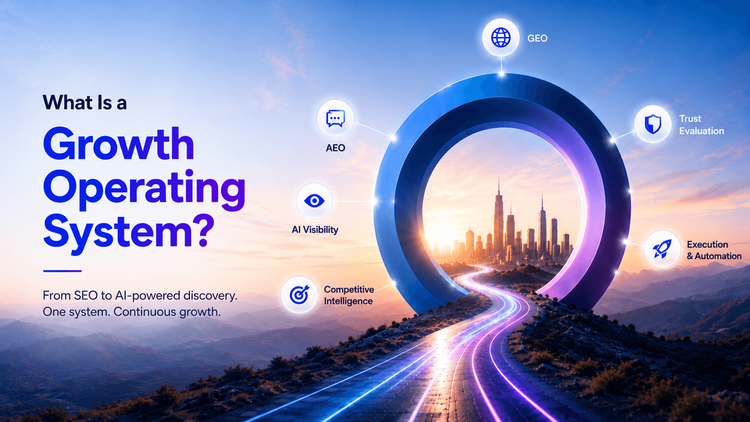
Buyers now research through AI-powered experiences — AI , Google AI Overviews, Gemini, Claude, Perplexity — that hand back a direct answer instead of ten blue links. Being indexed by a search engine is no longer the finish line; brands also need to be understood, trusted, and cited by AI systems. That shift in what "winning" means is where the concept of a Growth Operating System comes from: not another dashboard, but a system that connects SEO, GEO, AEO, AI Visibility, trust evaluation, and execution into one continuous workflow.
Why Traditional SEO Alone Isn't Enough Anymore
For years, marketing success tied back to one goal: rank higher on search engines. That worked when search engines acted mainly as directories pointing people to websites.
That model is cracking. SparkToro's long-running zero-click research (originally published by Rand Fishkin, updated with Datos clickstream data since) has found that a majority of Google searches in the US now end without a click to any website — the answer arrives directly on the results page. Gartner's "Predicts 2024" research separately projected a meaningful decline in traditional search engine volume by 2026 as more queries shift to AI chatbots. (Sources: SparkToro zero-click search study; Gartner, "Predicts 2024" — recommend confirming current figures before publishing, as both are periodically updated.)
Search is now multi-platform, and each platform judges differently
A typical buyer's research path today might touch Google Search, an AI Overview, a AI comparison, a Perplexity source-backed answer, and a review site — each one weighing technical quality, authority, structure, or citations differently. Most SEO platforms were built to measure rankings, backlinks, and crawl errors — genuinely valuable, but not built to answer "how often is our brand recommended by AI assistants," "which competitors are getting more AI citations," or "which content moves the needle across both Google and AI platforms at once." Answering those requires connecting insight to execution, not another report.
Meanwhile, the AI side of that shift is not a niche behavior anymore. OpenAI reported AI crossing 200 million weekly active users in August 2024, with growth continuing sharply since; Google rolled AI Overviews out to more than a billion monthly users across 100+ countries following its 2024 I/O announcement. (Sources: OpenAI public statement, Aug. 2024; Google I/O 2024/2025 — confirm current figures before publishing.)
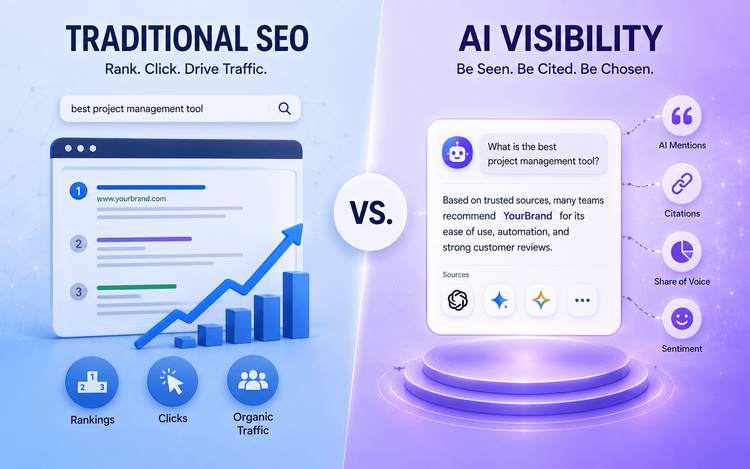
The practical problem this creates: your site can rank #1 for a valuable keyword and still never appear in an AI-generated answer, while a competitor with weaker rankings gets recommended instead because the AI system recognizes stronger authority or clearer structure. The question has quietly changed from "Where does my page rank?" to "Does my brand appear when a customer asks AI for a recommendation?" — and traditional SEO metrics alone can't answer that second question.
What Is a Growth Operating System?
A Growth Operating System is not another SEO suite, analytics dashboard, or content optimization tool — it's a different category, built for a world where AI assistants sit between a brand and its buyer. Most marketing technologies solve one problem well: an SEO suite tracks rankings, a content tool scores on-page relevance, a citation tracker monitors AI mentions. Individually useful; rarely connected.
Rather than asking a marketer to interpret five separate reports, a Growth Operating System continuously connects data, diagnosis, prioritization, execution, and measurement into a single cycle. Instead of just answering "what's wrong," it answers: what matters most, why, what to fix first, how to fix it, and whether the fix worked.
The Adviora Growth Intelligence Framework™
The system runs on five connected stages:
1. Discover — Pull in business intelligence beyond keyword rankings: technical SEO, Search Console and analytics data, content quality, competitor activity, brand mentions, AI-generated responses, personas, and trust indicators. The goal is a complete picture of digital presence, not just more data.
2. Diagnose — Prioritize findings by business impact instead of treating every technical issue equally: which gaps hurt AI visibility, which pages influence revenue, which trust signals are missing, where competitors are pulling ahead.
3. Prioritize — Rank opportunities against business value, AI visibility impact, competitive gap, technical effort, and expected ROI, so teams work on what moves outcomes rather than clearing a checklist.
4. Execute — This is where most SEO software stops at a report. A Growth Operating System instead generates deployment-ready recommendations — optimized metadata, structured data fixes, FAQ blocks, internal linking, entity optimization, AI-ready content structures — with human review still required before anything goes live.
5. Measure — Track the before/after impact of every change — rankings, AI visibility, citations, engagement, conversions — and feed it back into the next Discover cycle. Nothing is a one-time audit; algorithms, AI models, and competitors all keep moving.
SEO vs. GEO vs. AEO: What's Actually Different
These three terms get used interchangeably in a lot of marketing content, but they're distinct disciplines that complement rather than compete with one another.
| SEO | GEO | AEO |
| Optimizes for | Search engine rankings | AI-generated recommendations | Direct, extractable answers |
| Primary surfaces | Google Search | AI , Gemini, Claude, Perplexity | AI Overviews, featured snippets, voice search |
| Core signals | Keywords, crawlability, backlinks | Context, authority, trust | Structure, concision, extractability |
| Success metric | Rankings, traffic | Brand citations, Share of Voice | Answer/snippet visibility |
SEO makes sure your content can be discovered. AEO makes sure a search engine or AI system can lift a clean, direct answer out of it. GEO increases the odds your brand actually gets cited inside a generative response. None of the three replaces the others — together they cover both of the discovery surfaces buyers now use.
Why AI Visibility Is Becoming a Business Metric
Picture two competitors: Company A ranks #1 on Google for several high-value keywords. Company B shows up consistently across AI recommendations, AI Overviews, and Perplexity answers. Over the next few years, which one shapes more buying decisions? Increasingly, the answer depends on where the buyer started their research — which is why AI Visibility (how often and how accurately a brand is cited across AI platforms) is turning into a board-level metric rather than a niche SEO sub-measurement. A reality check worth sitting with: a Q1 2026 study of 177 brands across five industries found that roughly 90% had zero AI mentions across eight major platforms. (Source: as cited in industry AI-visibility research — recommend confirming the specific study before publishing.) That's not evidence the race is over; it's evidence most brands, including most of your competitors, haven't entered it yet.
Growth Operating System vs. Traditional SEO Tool
| Traditional SEO Tool | Growth Operating System | |
| Primary output | Reports issues | Recommends prioritized actions |
| Measures | Rankings, traffic | Business outcomes across search + AI |
| Coverage | Technical SEO | SEO + GEO + AEO + AI Visibility |
| Implementation | Manual | Guided execution workflow |
| Cadence | Periodic audits | Always-on monitoring |
| Tracking unit | Keywords | Entities, trust signals, citations |
To be clear: SEO tools haven't become obsolete — they're still the right choice for deep technical audits and backlink data. The difference is that modern teams also need a broader operational layer that turns fragmented activity into one coordinated system built for an AI-driven search ecosystem.
When Does Your Business Need One?
Consider a Growth Operating System if your organization is dealing with several of the following at once: multiple disconnected SEO/analytics/content tools; stable organic traffic but declining qualified leads; competitors showing up in AI or AI Overviews more often than you; the same technical SEO issues getting flagged repeatedly without resolution; priorities set by assumption rather than measured impact; or leadership expecting demonstrable ROI instead of isolated metrics.
A few concrete examples: a B2B SaaS company may rank well for product keywords yet barely appear in AI-generated product comparisons — closing that gap means strengthening topical authority and structuring content so it's citable. A university competing for AI-driven research visibility benefits from optimizing program pages and faculty expertise so prospective students get accurate AI recommendations. A professional services firm — where trust and expertise carry outsized weight — gains the most from strengthening E-E-A-T signals and entity recognition. An enterprise managing multiple business units gets centralized governance and shared benchmarks instead of optimizing each property in isolation.