
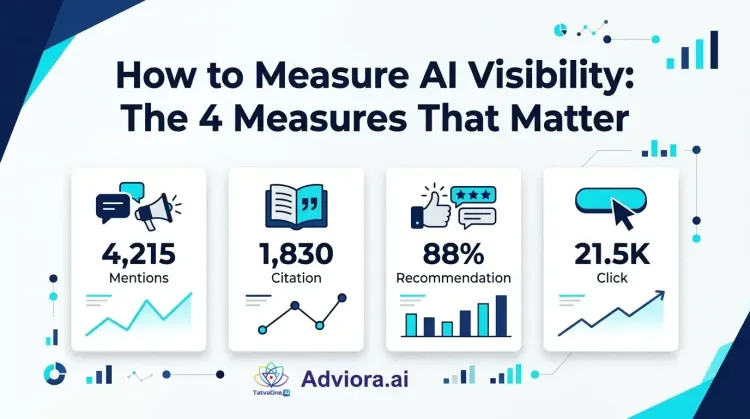
The four measures, defined with one example answer
- Mention: the answer names your brand.
- Citation: the answer links to your site or credits it as a source.
- Recommendation: asked to choose, the answer picks you.
- Click: someone visits your site from the answer.
An illustration (not a real answer). Prompt: "Which project tool should a ten-person agency use?" Answer: "Many teams like Brand A for its simple boards. Brand B is cheaper but has fewer integrations. For an agency of your size, I would pick Brand C." Sources listed: a review site and Brand C's pricing page. Read that as Brand A mentioned, not recommended and not cited; Brand B mentioned only; Brand C mentioned, recommended and cited. Whether anyone clicked is a fourth question, answered by your analytics, not by the answer.
Original element, to be supplied: a real prompt and answer from Adviora with each of the four measures marked on it, dated.
Why one blended score misleads
Engines move differently, so an average across them hides where you are strong and where you are absent. A single score also hides the gap between being mentioned and being chosen. LinkedIn practitioner Fred Yalmeh described a brand mentioned often that still loses the recommendation. Cassie Wilson Clark described being mentioned without being cited, and cited without being recommended. Anna Belova made the related point that being crawled, being cited and being clicked are three separate events. Those are practitioner views, but they match what the four measures show.
So report each measure, per engine, and show the zeros. Reddit posters in the same period described scores they could not audit; a score you cannot take apart is the reason. For how tools produce different numbers, see why AI visibility tools disagree.
Mentioned but not linked: why it happens and what to do
A mention moves awareness. A citation sends a reader to your site and shows the engine treats you as a source. A brand can have plenty of the first and none of the second. These three answers come from Adviora's own prompt panel, sampled through APIs on 15 October 2026 (not consumer-app answers):
| Example | What we saw | What it shows |
|---|---|---|
| A. A third party cited instead | An unbranded "best AI visibility tools" answer cited a listicle. About 128 citations went to third parties and none to adviora.ai. | The link went to someone else's page. |
| B. No mention, no citation | Adviora was absent from 15 of 15 unbranded cells. | The engines did not know us for these questions. |
| C. Named, not linked | The brand name appears in a sentence and the source list holds other sites. | The case this section is about. We have not yet logged a dated example of this from our own panel, so we are not inventing one. |
The causes to check, in order. This is a checking order, not a diagnosis; no single cause applies to everyone.
- Crawl access. The engine's search fetcher cannot reach the page, so it can name you from training data but has nothing to link. Check robots.txt groups, server response by user agent and CDN rules. See check your AI crawler access.
- Entity consistency and trust pages. The engine is not sure which "you" is meant. In our own case, Claude opened with "'Adviora' refers to multiple different entities" and cited demo.adviora.ai, and Gemini described the company from a Tracxn listing. Fixes: one name and one description on every listing, an about page with the legal entity and people, author bios, and Organization and WebSite markup.
- The cited source is someone else's page. The engine learned your name from a review site, listicle or Reddit thread and links to that. Fixes: get listed on the independent pages engines already cite, with your affiliation disclosed and no paid inclusion, and publish the answer-first page on your own site that deserves the link.
- Nothing to cite. Your page does not state the answer in its first 100 words, so the engine quotes a page that does.
A worksheet to copy, one row per prompt and engine:
| Prompt | Engine | Date | Named | Cited URL | Cited instead | Candidate cause | Fix |
|---|---|---|---|---|---|---|---|
| Best AI visibility tools | Any, API sample | 15 Oct 2026 | No | None | A third-party listicle | Cause 3 | Get listed on the pages engines cite |
| What is Adviora? | Claude | 15 Oct 2026 | Yes, as several entities | demo.adviora.ai | Not applicable | Cause 2 | One name, one description, about page |
Markup helps with cause 2 and does not fix cause 3, and no one can promise what an AI engine will say about a brand. For the full order, read how to improve AI search visibility: what to fix first. If you also want to see which sources engines cite for your own prompts, see AI citation tracking.
Sample size and variance
An AI answer changes between runs, so state the number of runs per prompt next to every figure and use the same number each time. Also state the share of unbranded prompts: branded prompts such as "What is Adviora?" came back 4 of 4 in our panel and tell you almost nothing, while the unbranded ones came back 0 of 15. Repeat observations matter because cited sources and brands change from run to run ("Don't Measure Once", arXiv 2604.07585). Prompt design is covered in which prompts to track.
Share of voice
Share of voice divides your mentions by all brand mentions across a fixed prompt set, engine set, run count and date range. It only means something when the denominator is stated. The method is in AI share of voice: define the denominator.
Clicks: GA4 and its gaps
Clicks are the only one of the four that your own analytics can see. GA4 has an AI Assistant channel for many AI visits, but it is a floor: answers that name you without a link send no visit, and links that arrive with no referrer or UTM tag are counted as Direct, as ChatGPT links were from 8 to 15 October 2026. Read track AI referrals in GA4 for the set-up and the gaps.
How Adviora reports each measure
Adviora shows what AI engines say about each of your products in each market, with share of voice and the sources each answer cites, so the mention and citation side can be read per engine. The free audit checks ChatGPT, Gemini, DeepSeek and Perplexity; a free trial or paid plan covers six AI engines plus Google AI Overviews. Prompts come from the site's messaging, what Google shows and People Also Ask questions. Clicks come from your own analytics. The methodology page sets out the definitions and the method, and AI visibility tracking shows the product.
The evidence behind any report should be checkable: the prompt, the engine, the market, the date, the number of runs and the raw answer. If a report cannot show those, treat its number as a claim, not a measurement. To get a baseline you can check by hand, run the free AI visibility checker.
What practitioners say: sources
- LinkedIn: Fred Yalmeh (mentioned often, still loses the recommendation); Cassie Wilson Clark (mentioned without being cited, cited without being recommended); Anna Belova (crawled, cited and clicked are three events).
- Reddit: threads in October 2026 on scores that cannot be audited (links held by the SEO lead).