How to Run an AI Visibility Audit on Your Own Website
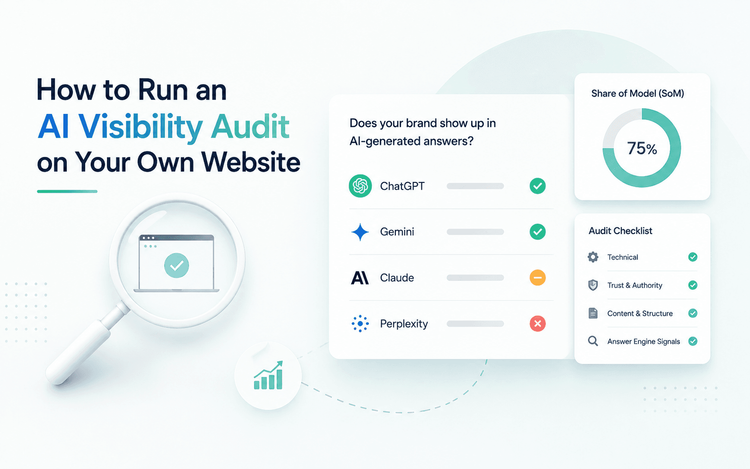
Somewhere in the last two years, "where do we rank" quietly became the wrong question. The more useful one is: when someone asks ChatGPT, Gemini, Claude, or Perplexity a question your business could answer, does your brand show up in the response at all?
That's what an AI visibility audit measures - a distinct, repeatable process, not a rebrand of a technical SEO crawl or something Google Search Console can answer for you. You can run a genuinely useful first pass yourself, this week, with a browser, a spreadsheet, and about half a day.
This guide walks through exactly how, using the same seven-part audit logic that underpins Adviora's own GEO and AEO engines - broken into steps a human can do manually, before deciding whether to automate any of it.
Why an AI Visibility Audit Is a Different Exercise Than an SEO Audit
A traditional SEO audit answers questions with a fairly stable, well-instrumented feedback loop: crawl errors show up in Search Console, rankings show up in a rank tracker, backlinks show up in Ahrefs.
AI visibility doesn't work that way yet, for three structural reasons worth understanding before you start:
There's no equivalent of Search Console. ChatGPT, Gemini, Claude, and Perplexity don't give site owners a dashboard showing which pages got cited, how often, or why. The only reliable way to find out is to ask the questions a real prospect would ask and read the answers yourself - exactly what Step 1 below walks through.
The ranking factors are still being reverse-engineered. Google's algorithm has been studied for two decades; what makes an AI system cite one source over another is being documented in real time, mostly through independent academic research rather than a published algorithm - why the citability step later in this guide leans on a specific peer-reviewed study rather than SEO folklore.
The output itself is unstable. Ask an AI assistant the same question twice on different days and you can get a different answer, different sources, or no citation at all. A single snapshot tells you less than a tracked baseline does - why this guide treats the audit as a monthly habit, not a one-off report.
None of this makes the exercise less worth doing - it makes it worth doing on a schedule, so you're comparing your brand's visibility against itself over time rather than drawing conclusions from one lucky (or unlucky) query.
The Share of Model Audit Framework: 7 Steps
Step 1: Establish Your Baseline Share of Model (SoM)
Before touching anything technical, find out where you actually stand. Share of Model is the percentage of your target queries where an AI assistant's answer mentions your brand at all - the single number this entire audit exists to move.
- Pull 15–25 real questions your buyers ask - mix category questions ("best project management software for agencies"), comparisons ("X vs Y"), and problem-based questions ("how do I reduce cart abandonment").
- Run each query manually in ChatGPT, Google's AI Overviews (or AI Mode), Gemini, Claude, and Perplexity, using fresh logged-out sessions where possible so personalization doesn't skew results.
- For each response, log: was your brand mentioned (yes/no); was a competitor mentioned instead; was the mention accurate; and was a specific page cited, versus just your brand name being namechecked.
- Divide mentions by total queries. That percentage is your baseline SoM - the number every later step in this audit exists to move.
Most businesses running this for the first time are surprised by how low the number is, even for brands that rank comfortably on page one of Google - that gap is precisely the problem this whole audit category exists to diagnose.
Step 2: Audit the Technical Foundation AI Crawlers Actually Need
AI assistants can only cite what their underlying crawlers can access and parse. Before anything else, confirm the basics are actually in place:
- Check robots.txt for AI crawler access. Major AI crawlers - OpenAI's GPTBot, Google's Google-Extended, Anthropic's ClaudeBot, PerplexityBot - use distinct user-agent strings. If any are blocked, deliberately or by an old, overly broad rule, that surface of your site is invisible to that assistant.
- Confirm clean crawlability and indexability - no orphaned pages, no accidental noindex tags on pages you want cited, a current sitemap.
- Check Core Web Vitals and mobile rendering. A page that's slow or broken when a reader clicks through undermines the citation even if it happened.
- Verify structured data is valid, not just present - malformed schema is functionally invisible to a parser that can't read it.
It's the least glamorous part of the audit and the easiest to skip - and the one that silently caps every other step's results if it's broken.
Step 3: Run a Trust & E-E-A-T Signal Check
AI systems, like Google, weight authoritativeness and trustworthiness heavily when deciding what to cite - arguably more so, since a citation is a stronger endorsement than a ranked link. Check for:
- Visible author bylines with real credentials, ideally with Person schema linking the author to their expertise.
- Clear, accessible About, Contact, and editorial-policy pages.
- Outbound citations to credible primary sources - content that cites nothing reads as less trustworthy to readers and AI summarizers alike.
- For YMYL topics (health, finance, legal, safety): heightened scrutiny of author expertise, since these carry the highest bar in every trust framework in public use.
There's no universal formula for exactly how many trust signals move the needle, so treat this as a gap-finding exercise rather than a scored test: list what's present and missing, and prioritize gaps on your highest-intent pages first.
Step 4: Score Your Content's Citability
This step has the most solid research behind it. A widely cited 2024 benchmark study - the "GEO: Generative Engine Optimization" paper, from a Princeton, Georgia Tech, and Allen Institute for AI-affiliated author group - tested content-optimization techniques across thousands of real queries and found specific, structural changes measurably increased a page's share of an AI-generated answer.¹ Distilled into four checks, that finding becomes the Citation Signal Framework:
| Signal | What to check on each page |
| Quotability | Does the page contain clear, self-contained sentences that directly answer a likely question - the kind of sentence an AI system could lift and quote verbatim? |
| Statistical grounding | Are there specific numbers, data points, or findings, rather than only qualitative claims? |
| Citation of authority | Does the page reference credible external sources, studies, or named experts to support its claims? |
| Freshness | Is there a visible, genuine last-updated date, and does the content reflect current information rather than a stale snapshot? |
Score your top 10–15 pages against these four signals - a simple yes/no/partial per page is enough for a first pass. Pages weak on all four are your highest-leverage rewrite candidates, since the research suggests these are the levers actually correlated with a citation.
Step 5: Check Your AEO Readiness
Answer Engine Optimization - winning featured snippets, People Also Ask boxes, and voice-search real estate - overlaps with GEO but isn't identical. Audit:
- FAQ coverage: do key pages answer specific questions in a scannable Q&A format, ideally with FAQPage schema?
- Featured snippet eligibility: for priority keywords, is a snippet showing, and is it yours or a competitor's?
- People Also Ask presence: are your topics generating PAA boxes, and does your content answer those exact phrasings?
A page that's strong on Step 4's citability signals but has no structured FAQ content is leaving an easy win on the table - FAQ schema is one of the fastest content changes to ship relative to its potential impact.
Step 6: Benchmark Against the Competitive Landscape
Your SoM number means little in isolation - it matters relative to who's winning the queries you're losing. Log which competitor (if any) got cited instead, for each query in your Step 1 set. Patterns emerge: one competitor consistently winning comparison questions, another dominating a sub-topic.
It's also worth knowing where the tooling landscape sits, since available tools shape what "doing this audit" means for different teams:
| Tool category | Examples | What they cover |
| Traditional SEO suites | Semrush, Ahrefs, Moz | Rankings, backlinks, crawl data - little to no AI-answer visibility |
| AI-native content tools | MarketMuse, Clearscope, Frase, SurferSEO | Content/keyword intelligence - not built to track AI citation behavior |
| Dedicated GEO/citation trackers | Profound, RankBee | Purpose-built AI-citation tracking, disconnected from technical SEO and execution |
| Unified growth platforms | Adviora | Runs all of the above as one connected audit, then generates the actual fix |
A lean team can do Steps 1–6 manually with a spreadsheet, as this guide describes. It gets harder to sustain once you're tracking dozens of queries across multiple platforms monthly - which is when most teams look for something that runs the audit for them.
Step 7: Set Up Ongoing Monitoring
A single audit is a snapshot; the value compounds when you repeat it. At minimum:
- Re-run your Step 1 query set monthly, using the same questions so the trend is comparable.
- Track SoM over time, not just its current value - a rising trend from a low base tells a different story than a flat trend from a high one.
- Consider publishing an llms.txt file - an emerging, voluntarily-adopted convention giving AI crawlers a structured summary of your key content, similar in spirit to a sitemap. Adoption is still evolving across platforms, so treat it as a low-cost, forward-looking addition, not a guaranteed lever.
- Revisit Steps 2–5 quarterly, since technical and content signals shift more slowly than AI-generated answers do.
Why This Matters Right Now
The urgency isn't hypothetical. SparkToro's research has repeatedly found that a majority of Google searches - roughly 58–60% in the U.S. by its most recent widely cited update - now end without a click.² Google's AI Overviews reached an estimated 1.5 billion monthly users around its 2025 I/O announcement.³ OpenAI reported ChatGPT crossing 200 million weekly active users as of August 2024, almost certainly higher since.⁴ Gartner's "Predicts 2024" research projected organic search volume could decline meaningfully by 2026⁵ - territory Semrush has separately projected could see LLM-driven traffic overtake organic search later this decade.⁶
Separately, a Q1 2026 industry study reportedly found a large majority of sampled brands - cited around 90% in some reporting - had zero mentions across major AI platforms for their category terms.⁷ That figure recurs without a single confirmed primary source attached, so treat it with caution. Whatever the precise number, the directional finding matches what most first-time Share of Model audits actually turn up.