Generative Engine Optimization (GEO): What It Is and Why It Matters
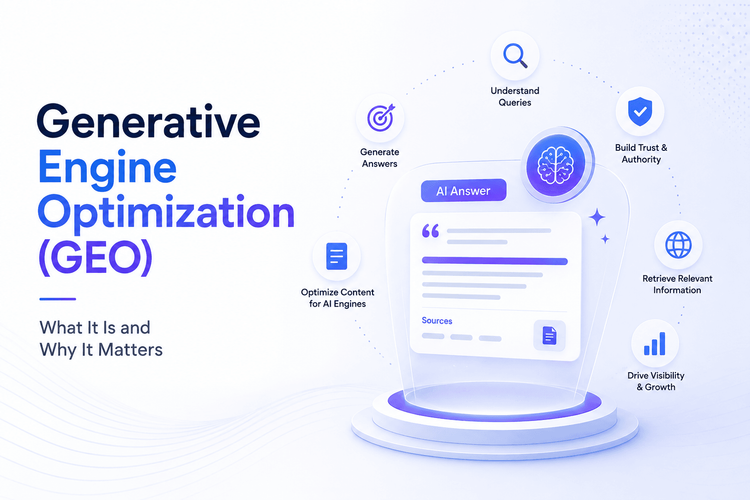
A growing share of buyer research now happens inside a single conversation with an AI system instead of a scroll through ten blue links - and if your brand isn't the one that conversation cites, it doesn't matter how well you'd have ranked on the results page nobody looked at. That's the problem Generative Engine Optimization (GEO) exists to solve: not getting a page ranked, but getting a brand cited, quoted, or recommended inside the answer a generative AI system actually writes.
This guide defines GEO clearly, explains why it's become a distinct discipline rather than a rebrand of SEO, walks through what the (thin but growing) research base says actually moves the needle, and maps the competitive landscape of tools built to track and improve it.
What Is GEO, Exactly?
GEO is the practice of optimizing content so a generative AI system chooses to cite it when constructing an answer. That's a meaningfully different job than classic SEO. Search engines rank a list of pages and let a human pick one; generative engines synthesize a single answer from multiple sources and decide, on the system's own judgment, which sources earned a place in that synthesis. Ranking #1 on Google says nothing about whether a page gets selected for that synthesis - the selection criteria are different, and often invisible to the page owner.
GEO sits alongside two closely related terms that get used almost interchangeably in current industry practice: AEO (Answer Engine Optimization), generally used for winning direct-answer placements like featured snippets and voice results, and AI visibility, the broader measurement umbrella covering both. In practice, most vendors and practitioners treat GEO and AEO as describing the same underlying job - earning a citation inside a machine-generated answer - with GEO emphasizing the newer, fully generative platforms (ChatGPT, Gemini, Claude, Perplexity) and AEO carrying more of the legacy snippet/voice-search lineage.
Why GEO Matters Now
Three shifts, happening together, explain why this has become its own discipline rather than a minor SEO update.
Buyers stopped clicking through. SparkToro's long-running zero-click research puts the share of U.S. Google searches ending without a click at roughly 58–60% in its most recent widely-cited figures.¹ The answer arrives on the results page - or inside a chat window - and the searcher never visits a website at all.
Generative platforms reached genuine scale. Google's own AI Overviews reportedly reached roughly 1.5 billion monthly users following its expansion around Google I/O 2025.² OpenAI separately reported ChatGPT crossing 200 million weekly active users in August 2024, with growth continuing since.³ Neither of these is a rounding error against total search volume - they represent a structural shift in where research queries actually land.
Forecasters are pricing in a lasting shift, not a fad. Gartner's "Predicts 2024" research projected a meaningful decline in traditional search engine volume by 2026 as more queries move to AI chatbots,⁴ and Semrush's own research separately projects that LLM-driven traffic could overtake traditional organic search traffic by 2028.⁵ Both directional claims point the same way even though they come from different organizations with different methodologies.
The Evidence Base: What Actually Moves an AI Citation
Most GEO advice in circulation is closer to educated guessing than tested science - which makes the one controlled academic study on this topic worth taking seriously. Researchers affiliated with Princeton, Georgia Tech, and the Allen Institute for AI published a benchmark study, commonly referred to as "GEO: Generative Engine Optimization," testing content-optimization techniques across a large set of queries.⁶ The study's headline finding: specific, testable changes to a page measurably increased how much of a generative answer that page's content ended up occupying. Distilled into four signals, in roughly the order the evidence supports:
- Quotability - adding direct quotations from credible sources produced a meaningful, measurable lift in the study.
- Statistical grounding - adding relevant, specific statistics also produced a measurable improvement.
- Citation of authority - referencing authoritative external sources improved visibility as well.
- Freshness - content addressing commercial and evaluation-stage queries appears to draw more citations when recently updated rather than left stale, consistent with general GEO practitioner guidance.⁷
*(The exact per-technique percentages sometimes quoted for this study should be checked against the published paper directly before being restated as precise numbers on a live page - the direction and general magnitude of the finding is well-supported; exact sub-figures deserve a citation check.)*
Two structural factors compound these four signals. Entity consolidation - using a consistent brand name and description everywhere it appears online - helps a model recognize scattered mentions as one organization rather than several. Co-occurrence - being consistently mentioned alongside the topics you want to be known for, on sites other than your own - helps a model associate your brand with a category rather than just a single page.
The GEO Tool Landscape
The market serving this discipline is still young, and it splits into three camps rather than one mature category.
| Category | Examples | What they're built for | Where they fall short |
| Traditional SEO suites | Semrush, Ahrefs, Moz, BrightEdge | Deep keyword, backlink, and technical audit data; several (Semrush, Ahrefs) have added AI Overview or "brand visibility" tracking since 2024–2025 | GEO coverage is new, bolted-on, and narrow relative to their core product |
| Content optimization tools | Clearscope, MarketMuse, Frase, SurferSEO | NLP-driven content scoring and topic/keyword mapping | No native AI-citation tracking, no technical SEO depth |
| Dedicated GEO / AI-citation trackers | Profound, Otterly.ai, RankBee, Peec AI, and similar newer entrants | Purpose-built tracking of brand mentions and citations across ChatGPT, Perplexity, Gemini, and AI Overviews | Narrow by design - visibility measurement only, with limited technical SEO or execution capability |
None of these three camps currently spans the full loop from measuring GEO performance to fixing the underlying content to proving the fix worked - which is the gap a broader "growth operating system"-style platform is built to close, and worth naming honestly as a different category from a point GEO tracker.
The Reality Check: This Is an Early Race, Not a Crowded One
A recent industry study of a sample of brands across multiple industries found that the large majority had zero AI mentions across major AI platforms.⁸ *(This figure is carried over from elsewhere in this content series; recommend confirming the exact study and percentage before publishing, per the sourcing notes below.)* Whatever the precise number, the direction is consistent across everything published on this topic so far: most brands, likely including most direct competitors in any given category, don't yet have a measurable GEO footprint. That's the opposite of a crowded market - it's an open one.
The Measurement Catch Nobody's Analytics Solved Yet
Because generative answers are largely zero-click, a visit that does eventually happen after an AI recommendation often shows up in analytics as "organic" or "direct" traffic rather than attributed to the assistant that actually drove it. Until platform-level attribution catches up, the practical fix is blunt: add a self-reported attribution question - "How did you hear about us?" - to lead forms, and track "AI assistant" as its own category rather than letting it disappear into an existing bucket.