AI Visibility Across Six AI Engines
Adviora’s observational research analyzes 5,039 successful AI execution records across six artificial intelligence engines to evaluate brand visibility, competitor mentions, external citations, and model-assessed sentiment.
Published Oct 30, 2026Updated Oct 30, 2026

Core Findings
- Mentions vs. Citations: Brand mention visibility is not synonymous with citation visibility. The target brand appeared in 17.4% of successful responses, yet 28.6% of those mentions had no saved citation to the target domain, and 15.0% lacked any citations entirely. Conversely, domain citations occasionally occurred without the brand being explicitly named.
- Cross-Engine Disagreement: Among tracking runs with responses from at least three engines, 38.2% showed operational disagreement containing a mix of brand-mentioned and absent answers.
- Configuration Dependence: Citation availability varies wildly across engine setups, ranging from 100% coverage on fully enabled configurations down to 0.1% when web search features are disabled.
- Ecosystem Diversity: Extracted citations span multiple source types, heavily mixing commercial providers and brands (28.1%), academic and research platforms (22.5%), and retailers (14.8%).
- Sentiment Breakdown: Out of the recorded target-brand mentions, sentiment models classified 53.4% as neutral and 46.1% as positive, with minimal negative scoring (0.5%).
Executive research summary
The connected Adviora exports cover 5,470 attempts at AI executions and 5,039 successful responses. They cover 767 prompt records (related to 723 unique, distinct, normalized stored texts), 17 anonymous companies, 118 tracking runs, and 6 AI engines. The data are actual execution records from live systems. They are not records from a controlled experiment, and they do not make up a balanced, daily panel: the measurements are taken on eight different calendar days within a 19-day, inclusive period.
The data, principally, show that there is no single, interchangeable, aggregate metric that covers the extent of AI visibility. Detection of brand mentions, Competitor mentions, external citations, domain citations and model-assessed sentiment all describe attributes of an answer. How measurements are structured and what prompts are sourced from materially affect what comparisons can be legitimately made.
Of the 1,014 tracking run/prompt groups with responses from at least three engines, 387 (38.2%) contain a mix of brand mentioned and brand not mentioned answers. This is operational disagreement between the engines. Because configurations and prompts can be different from engine to engine, it should not be read as a controlled benchmark in which all the engines answer the same question.
Headline indicators
| Indicator | Observed | Interpretation |
| Successful executions | 5,039 / 5,470 (92.1%) | Attempt-level completion rate |
| Prompt records | 767 | Database prompt IDs, not equivalent to independent buyer intents |
| Distinct normalized stored prompt texts | 723 | Lowercased and stripped stored prompt text, not semantic deduplication |
| Target-brand-mentioned responses | 878 / 5,039 (17.4%) | Response-level detection, non-mention is a valid zero |
| Competitor-mentioned responses | 984 / 5,039 (19.5%) | Response-level detection, can overlap with brand mentions |
| Responses with citations | 3,013 / 5,039 (59.8%) | Any saved citation across all engines |
| Citation occurrences | 33,384 | Rows include repeated URLs/hosts within responses |
| Distinct citation domains | 5,108 | Across collected citation rows |
| Observed dates | 8 | Not daily across the full window |
1. Dataset, lineage and validation
The data used for analysis is Adviora.ai's historical execution data with frequency and coverage. All 5,039 successful executions have stored responses, and child tables are joined to recorded executions with no orphan IDs in the checked exports.
There are four analysis units. An execution is defined as one attempt of prompt + engine + run, and a response is defined as one successful execution. A response can capture multiple competitor/brand mentions and several citation occurrences. Child tables are aggregated at the response or execution level prior to the join, resulting in a 1-to-many relation, which prevents inflating rows.
Two things interpreted by the user were verified. When an entry for a brand mention or citation is missing, the user affirmed that it was not due to incomplete extractions. The user also confirmed the engine-model mapping was done correctly. Sentiment labels are provided by the user by passing the answer text and/or context to the OpenAI API classification endpoint to classify. Though this makes the classification process known, it does not prove that each classification is correct.
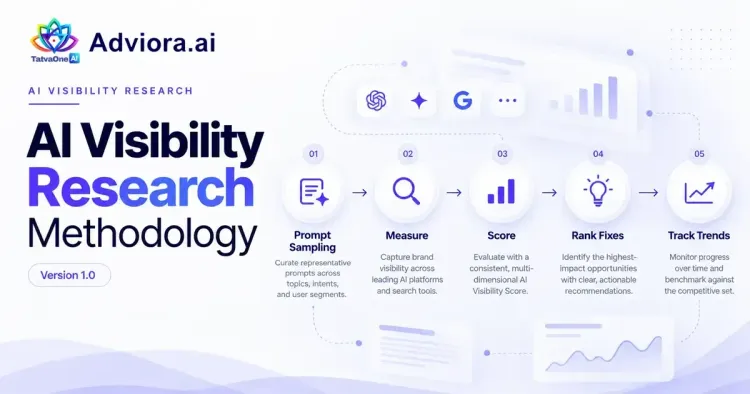
2. Sampling and measurement methodology
2.1 - Prompt identity and construction
Prompt IDs must be shown at multiple levels: 767 prompt IDs at the database level, 723 lowercased and trimmed stored texts, and prompt-engine-executed-text cohorts for comparison. The number of semantically distinct buyer intents can't be inferred without a semantic analysis. Many prompt IDs run with different wording on different engines, meaning a fixed prompt ID is not a fixed, verbatim experimental question.
| Origin/cohort | Unique prompt IDs | What it means |
| Unbranded PAA | 360 | Stored cohort label, unbranded source framing |
| PAA-derived | 285 | Stored cohort label, transformed PAA questions |
| Generated | 122 | Stored cohort label, generated prompts |
| Website-derived source | 646 | Discovery-source label, overlapping cohort classification |
| Manual source | 121 | Discovery-source label, overlapping cohort classification |
Source and cohort are two independent dimensions, therefore the five rows shown above overlap and are not mutually exclusive groups. When describing the prompt generation pipeline, editors may use the recorded source labels and avoid using process artifacts to specify prompts, templates, and the filtering criteria, and human approval, unless absolutely necessary. In the case of the prompt definitions, feel free to call them an ‘intent diverse panel’ in editorial copies. It is best not to call them an ‘ad-hoc sample of all buyer questions’ as that is not an accurate representation.
2.2 - Schedule, frequency and missingness
The observed starts were on October 5, 8, 9, 14, 15, 16, 22, and 23, 2026. The counts show the days measurements were made and do not indicate the planned frequency of runs. Planned run calendars were not provided. The covered population is known, however, schedule compliance cannot be determined. Timed-out and failed attempts are left in the reliability denominator and are not included in content-outcome denominators.
2.3 - Locale, models, and web search
The documented target markets covers a number of countries. Most prompt responses reference the US, Colombia, Panama and the Dominican Republic, along with some English-speaking markets. Language codes include en, es and English, while country codes include US, PA, DO and Zambia. These codes should be standardized before any locale comparison. A requested locale also does not ensure that the provider restricted its response to that locale.
| Engine ID | Model recorded in successful exports | Successes | Web-search flag |
| 1 | gpt-4o-mini | 942 | Enabled |
| 2 | claude-haiku-4-5-20251001 | 842 | Enabled |
| 3 | gemini-2.5-flash | 1,014 | Enabled |
| 4 | openai/gpt-6-luna | 1,014 | Enabled |
| 5 | deepseek-flash | 974 | 973 disabled, 1 enabled |
| 6 | mistral-medium-latest | 253 | Enabled |
The web_search_used field contains the execution classification. Without additional information, it does not show if a search was executed for a given response, how many searches were executed, or whether the response was grounded in reality. Cross-engine citation patterns need to be read with these settings and the provider’s tools and extraction methods.
3. Core research findings
Finding 1: Mention visibility is not citation visibility
The target brand appeared in 878 successful responses (17.4%). Of these, 251 (28.6%) had no saved citation to the target domain, and 132 (15.0%) had no saved citation of any kind. This shows that a brand can appear in an answer that doesn’t cite the brand’s domain. The reverse also happens: citations of the target domain appeared in 130 answers without the target brand being mentioned. Presence of the brand and attribution of source are different things that occur simultaneously.
In marketing, mentions of a brand, recommendations of a brand, citations of the brand’s domain and third party citations of the brand answer different questions. A citation is not necessarily an endorsement of the brand. A mention of the brand is not the same as a recommendation.
Finding 2: Cross-engine visibility varies within tracking runs
Of tracking-run/prompt groups with at least three engine responses, 387 of 1,014 (38.2%) combined at least one detected target-brand mention with at least one absent mention. In total, 412 groups had the brand mentioned by at least one engine, and 25 groups had a mention by every engine represented. Thus, 387 of the 412 groups with any mention at all (93.9%) fell short of unanimous mention presence.
There is a limitation here. There is slight variation in the executed prompt across engines, as well as variation in models and web-search settings. The result captures some real-world variation and may not be an estimate of model effect pure and true. There is also variation in the business mix and prompt-cohort mix.
Finding 3: Citation availability is strongly configuration-dependent
| Engine ID | Successful responses | Responses with citations | Citation coverage | Citation occurrences |
| 1 | 942 | 361 | 38.3% | 2,579 |
| 2 | 842 | 502 | 59.6% | 4,189 |
| 3 | 1,014 | 980 | 96.6% | 14,530 |
| 4 | 1,014 | 1,014 | 100.0% | 11,148 |
| 5 | 974 | 1 | 0.1% | 5 |
| 6 | 253 | 155 | 61.3% | 933 |
We expect little to no citation capture by Engine 5, considering it was run with Web search disabled. This is not an extraction error. Additionally, it doesn't mean the model is citation-averse. The other engines also vary by output format of the provider, search features and mix of prompts. Thus, raw citation counts should not be used to compare engines for quality or authority.
Finding 4: Citation ecosystem mixes commercial and independent source types
| Stored effective citation category | Occurrences | Share |
| Commercial providers and brands | 9,391 | 28.1% |
| Academic and research | 7,505 | 22.5% |
| Retailers and marketplaces | 4,930 | 14.8% |
| Other/unclassified | 2,922 | 8.8% |
| Editorial publishers and reviews | 2,321 | 7.0% |
| Associations and nonprofits | 2,172 | 6.5% |
| Communities and forums | 1,480 | 4.4% |
| Government and public bodies | 920 | 2.8% |
| Directories and reviews | 913 | 2.7% |
| Social and creator platforms | 830 | 2.5% |
The table lists citation counts. It does not list unique sites, and does not verify which sources influenced a recommendation. It does not examine which sources influenced the multiple recommendations made to the same site. Category labels were assigned by the classification pipeline (version 1.0) and include manual overrides where present. The mix describes this heterogeneous business portfolio and the configurations measured, it does not describe the AI-search ecosystem in general.
Finding 5: Historical changes exist, but the repeated panel is sparse
An enhanced repeat analysis kept only successful responses that had the same ID for prompt, engine, and text, as well as language and country, model, web search flag, locale method and analysis version. It took only one of each observation per date. This produced 656 comparable panels spanning at least two dates. Of these, 307 spanned two dates and 349 spanned three.
| Change metric | Changed panels | Denominator | Proper interpretation |
| Brand-mention presence | 18 | 656 | At least one observed switch between present and absent |
| Any citation presence | 33 | 656 | At least one switch in presence of extracted citation |
| Target-domain citation presence | 20 | 656 | At least one switch in target-domain citation |
Only 49 of the 656 repeated panels registered the target brand at least once. So panels in which the brand is never mentioned make up the large majority of the low overall switching fraction. Of the 49 ever mentioned panels, 18 (36.7%) switched at least once. That’s a selected, conditional rate, and therefore can’t be generalized to all prompts. The sample does not provide evidence for a day-to-day volatility trend over the 2-week period, nor does it provide evidence to support a causal claim.
Finding 6: Sentiment labels provide a distinct qualitative layer
For the 878 records of target brand mentions, the OpenAI API classification returned 469 NEUTRAL (53.4%), 405 POSITIVE (46.1%), and 4 NEGATIVE (0.5%). For the competitor mentions (2,375 records), we obtained 1,697 NEUTRAL (71.5%), 630 POSITIVE (26.5%), 24 NEGATIVE (1.0%) and 24 unlabeled (1.0%). The 24 unlabeled competitor rows should not be silently recoded to NEUTRAL.
These labels represent a model’s assessment of competitor mentions in a given AI response. These do not reflect public consumer sentiment or customer satisfaction. It is important to understand the context in which the samples were collected. The samples were selected by business, prompt intent, and engine, therefore, raw competitor versus target mentions percentages do not reflect an accurate comparison of performance. Scores and confidence are still useful for stratification, however some stored confidence values are 0.
Finding 7: Prompt provenance correlates with different detected mention rates
| Prompt cohort | Successful responses | Brand-mentioned responses | Detection share |
| Generated | 1,401 | 228 | 16.3% |
| PAA-derived | 1,669 | 410 | 24.6% |
| Unbranded PAA | 1,969 | 240 | 12.2% |
In this export, executions of PAA-transformed questions show higher unadjusted brand mentions. The association is descriptive. It doesn’t mean transforming PAA questions makes brands more visible. There are differences in the cohorts in business, brand, model, locale, intent and execution mix. Estimating a prompt-framing effect would require a controlled comparison matched for business and engine.
4. Citation support and classification nuances
Of the 33,384 citations, supports_client_brand is true for 649 (1.9%), false for 7,401 (22.2%) and null for 25,334 (75.9%). A missing citation row is verified as an absence, and a NULL support classification is not the same as a negative support classification and should be left undefined. No overall rate of “sources supporting brands” should be calculated and interpreted as though NULL meant false for all citation rows.
Support classifications are algorithmic judgments about a source’s relevance. They do not prove a source caused the model to mention a brand. Research on placement opportunity needs to distinguish three things: cited-domain prevalence, target-domain presence and assessed source support.
5. What the evidence does and does not prove
The data shows: multiple prompt panels per business, repetitive executions, cross-engine variations in observed mentions, engine-specific citation footprints, AI-assessed sentiment labels and a diversified citation ecosystem.
The data does not show universal, market-wide AI visibility percentages, 14-day tracking of the same prompts, or experimental attribution of differences solely to model choice. Additionally, it does not show a citation caused a recommendation, or that a marketing action increased visibility.
Answers to the same questions are correlated to prompt and business and across repeated executions, thus confidence intervals should not be shown for each answer as if they were independent.
The results are representative of the prompts configured and the business mix. Less common category-locale combinations are deliberately omitted to protect the client’s identity.
Appendix: metric definitions
| Metric | Definition |
| Brand mention rate | Successful responses with ≥1 target-brand mention / all successful responses in the cohort |
| Competitor mention rate | Successful responses with ≥1 competitor mention / all successful responses in the cohort |
| Citation-bearing response rate | Successful responses with ≥1 citation / all successful responses |
| Citation occurrences | Number of extracted citation records, including repeats |
| Target-domain citation rate | Successful responses with ≥1 is_target_domain citation / all successful responses |
| Cross-engine disagreement | Matched tracking-run/prompt groups with mixture of detected and absent mention, conditional on ≥3 engines |
| Observed measurement frequency | Distinct started_at dates per prompt × engine, distinct from scheduled measurement frequency |
| Repeated-panel switch | At least one present/absent transition across 2+ observed dates with comparison controls unchanged |
| AI-assessed sentiment share | Mentions assigned each label / mentions with recorded classification, with NULL stated separately |
The export was verified against the provided data-verification CSV (5,039 successful responses, 878 with brand mentions, 984 with competitor mentions, 3,013 with citations), and the data owner confirmed the authoritative business and engine mapping. All counts describe the supplied snapshot, taken on or before 28 October 2026.
Research transparency
This publication contains no client names, identifying domains or identifying individual prompts. It describes observed samples and their methodological limits, and the primary execution data are kept private.
Frequently asked questions
Adviora’s observational research analyzes 5,039 successful AI execution records across six artificial intelligence engines to evaluate brand visibility, competitor mentions, external citations, and model-assessed sentiment.