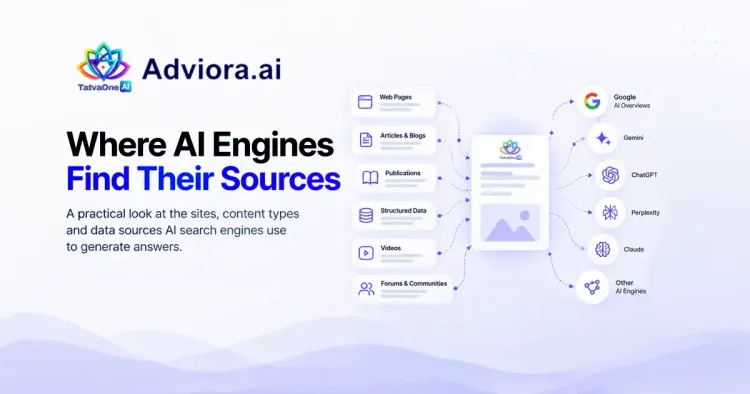
Where AI Engines Find Their Sources
Adviora’s analysis of 33,384 citation occurrences across six AI engines and 17 anonymized businesses reveals how source distribution shifts dramatically by industry and engine.
Published Oct 30, 2026Updated Oct 30, 2026
Quick answer
Adviora’s analysis of 33,384 citation occurrences across six AI engines and 17 anonymized businesses reveals how source distribution shifts dramatically by industry and engine.
Abstract
AI visibility reports often treat every citation as the same kind of event. In practice, a citation to the tracked business's own website, a retailer, an academic institution, a community forum or an editorial publisher each reflects a different observable source relationship. This study examines 33,384 recorded citation occurrences in AI responses generated by six AI engines for 17 anonymized businesses, grouped into nine analytical categories. It introduces a separate Self-brand citation category and then describes the relative share of the other website-source categories within each engine and business category.
Across all pooled citation occurrences, 27.94% are classified as external commercial providers and brands, 20.69% as academic and research sources, and 12.31% as retailers and marketplaces. Another 1,596 occurrences (4.78%) cite the tracked business's own domain; these are reported as Self-brand and kept apart from third-party sources. The mix shifts substantially by industry and engine. Higher-education prompts cite academic sources prominently, sportswear and footwear prompts draw heavily on retailers and commercial providers, and technology-related prompts show large commercial-source shares. All of this describes the captured responses. It is not experimental proof of platform source preferences, and it is not causal evidence that a citation shaped an answer.
Keywords: AI visibility; citations; generative search; source taxonomy; brand visibility; industry-specific source patterns; AI engine comparison; self-brand citations.
Executive findings
- Industry context matters. The source categories recorded most often differ across higher education, sportswear retail, jobs and recruitment, professional education and technology-related businesses.
- Each engine has its own source composition. Within comparable industry groupings, engines show different recorded citation-category mixes. That does not prove an underlying model preference, because prompt wording, response generation, web search and extraction practices all differ.
- A business's own domain is not a third-party signal. Moving 1,596 citations into Self-brand keeps them from falsely inflating the commercial, academic or retail category totals.
- Commercial and institutional sources lead by volume. Once Self-brand is separated out, external commercial, academic/research and retailer/marketplace citations together account for approximately 61% of all occurrences.
- Being cited is not the same as supporting the brand. A cited domain has not necessarily endorsed or supported the tracked brand, or caused it to be recommended.
- Visibility needs to be measured on several axes. Source category, unique-domain breadth, citation occurrence frequency, Self-brand citations and brand or recommendation mentions each answer a different research question.
1. Research objective and questions
The study asks four questions: (a) which kinds of domains are visibly cited in the sampled AI-generated answers; (b) how the source-category mix changes by business category and AI engine; (c) how the conclusions change when Self-brand citations are treated separately; and (d) which limits have to be acknowledged before these distributions are read as source preferences or marketing opportunities.
This is a retrospective observational analysis of Adviora's execution and citation exports. It does not test why a given model chose a source, and it does not establish that an engine retrieved, read or relied on every extracted URL when it composed its response.
2. Data and measurement design
The observation window runs from 5 to 23 October 2026 and contains eight distinct execution dates, not a continuous daily sequence. The broader execution history covers 5,470 attempts, 5,039 successful AI responses, 767 unique prompt records, 118 tracking runs and six engines across 17 anonymized businesses. This analysis uses the 33,384 citation occurrences found in extracted response citations. That figure is not a count of 33,384 unique sources or 33,384 different answers.
A fixed prompt identifier does not guarantee identical wording across engines, so any stringent matched-panel study must use the recorded executed-prompt text, locale, search configuration, model and date. Business categories were inferred from business and prompt context. They are researcher-defined and are not verified industry classifications. The sample is nonrandom, and the sectors differ in size.
2.1 - Industry composition
| Anonymized business category | Businesses | Citation occurrences | Share of all citations |
| Sportswear and footwear retail | 6 | 12,680 | 38.0% |
| Medical education communities | 2 | 7,248 | 21.7% |
| Higher education | 2 | 6,926 | 20.7% |
| Medical education information | 2 | 2,472 | 7.4% |
| Jobs and recruitment | 1 | 1,701 | 5.1% |
| Professional education | 1 | 1,116 | 3.3% |
| Marketing technology | 1 | 804 | 2.4% |
| Property technology | 1 | 331 | 1.0% |
| Travel and tourism | 1 | 106 | 0.3% |
| Total | 17 | 33,384 | 100.0% |
Several business categories contain only one tracked business, so their distributions describe that one case's prompt panel and are not an industry-wide average. Sportswear and footwear has six businesses and accounts for a disproportionately large fraction of all citation occurrences.
2.2 - Engine volume and comparability
| Engine | Citation occurrences | Share of all citation occurrences |
| Gemini | 14,530 | 43.5% |
| Engine 4 (OpenAI routed) | 11,148 | 33.4% |
| Claude | 4,189 | 12.5% |
| ChatGPT API | 2,579 | 7.7% |
| Mistral | 933 | 2.8% |
| DeepSeek | 5 | 0.0% |
ChatGPT API, Claude and Gemini are kept distinct from Engine 4, which is a separate OpenAI-routed configuration. Mistral has a smaller captured citation sample. DeepSeek contributes only five citation occurrences, so no meaningful percentage comparison is made for it. Model names follow the recorded export and do not suggest equivalence with how the consumer-facing apps behave.
Responses with no extracted citations are genuine observations, as the dataset owner confirmed. Even so, differences in web-search enablement, provider APIs and extraction mechanisms can strongly affect citation coverage. The tables show the source mix conditional on citations having been captured. They do not show the probability that a model will cite a given source category in an answer.
3. Citation taxonomy and Self-brand treatment
The underlying data stores ten citation source categories, including other/unclassified, with manual overrides where recorded. For this study, any citation with is_target_domain = 1 is classified as Self-brand, whatever its previous type. Every other citation keeps its effective source category, and a manual override takes precedence where one exists. The result is eleven mutually exclusive reporting categories.
Self-brand describes a domain relationship. It does not indicate positive sentiment or third-party endorsement. A third-party commercial site that mentions the tracked brand stays an external commercial citation; it becomes Self-brand only if the citation points to the tracked business's own domain. Repeated citations to the same URL count as separate occurrences.
3.1 - Full source-category distribution
| Citation category | Occurrences | Share |
| External commercial providers | 9,326 | 27.94% |
| Academic / research | 6,907 | 20.69% |
| Retailers / marketplaces | 4,109 | 12.31% |
| Other / unclassified | 2,886 | 8.64% |
| Editorial / review | 2,321 | 6.95% |
| Associations / nonprofit | 2,172 | 6.51% |
| Self-brand | 1,596 | 4.78% |
| Communities / forums | 1,443 | 4.32% |
| Government / public | 920 | 2.76% |
| Directories / review platforms | 874 | 2.62% |
| Social / creator | 830 | 2.49% |
[Figure: Share of recorded citation occurrences by source category]
The three largest external categories are commercial providers and brands, academic and research sources, and retailers and marketplaces. Social/creator and communities/forums make up considerably smaller shares in this particular corpus. That is not evidence that these channels are unimportant for discovery, influence or brand perception, or in other industries.
3.2 - Unique domains and citation repetitions
Occurrence shares should be read together with the unique-domain counts that accompany them. One category might hold a wide variety of domains each cited once, while another holds a narrow set cited repeatedly. The distinct-domain counts in the research annex are based on normalized domains and the category assigned within each engine. Any domain with conflicting source classifications should be manually reviewed before an authoritative list of source types is derived from it.
4. Citation patterns by industry and engine
For each industry and engine, the denominator is every recorded citation occurrence in that industry–engine cell, Self-brand and Other/unclassified included. The tables list the leading categories only, not the whole distribution; the companion CSV has all eleven categories and the unique-domain counts. Small cells are deliberately not emphasized.
[Figure: External commercial share by industry and engine]
Sportswear and footwear retail
| Engine | Citation occurrences | Leading categories within engine–industry subset |
| ChatGPT API | 1,598 | Other / unclassified 49.8%; Retailers / marketplaces 19.0%; External commercial providers 17.0% |
| Claude | 1,058 | External commercial providers 33.1%; Retailers / marketplaces 32.1%; Editorial / review 13.7% |
| Gemini | 5,919 | External commercial providers 34.1%; Retailers / marketplaces 32.6%; Self-brand 8.6% |
| Engine 4 (OpenAI-routed) | 4,105 | Retailers / marketplaces 34.4%; External commercial providers 25.1%; Editorial / review 14.6% |
Medical education communities
| Engine | Citation occurrences | Leading categories within engine–industry subset |
| ChatGPT API | 110 | External commercial providers 41.8%; Academic / research 16.4%; Associations / nonprofit 8.2% |
| Claude | 945 | External commercial providers 38.7%; Academic / research 31.6%; Associations / nonprofit 11.5% |
| Gemini | 3,334 | External commercial providers 31.2%; Academic / research 29.8%; Associations / nonprofit 14.2% |
| Engine 4 (OpenAI-routed) | 2,400 | Academic / research 36.0%; Associations / nonprofit 24.5%; External commercial providers 17.1% |
| Mistral | 459 | External commercial providers 35.1%; Academic / research 19.8%; Communities / forums 15.0% |
Higher education
| Engine | Citation occurrences | Leading categories within engine–industry subset |
| ChatGPT API | 562 | Academic / research 41.1%; Other / unclassified 14.8%; External commercial providers 12.8% |
| Claude | 952 | Academic / research 33.7%; External commercial providers 33.4%; Other / unclassified 8.3% |
| Gemini | 2,742 | Academic / research 41.5%; External commercial providers 18.9%; Self-brand 10.1% |
| Engine 4 (OpenAI-routed) | 2,567 | Academic / research 49.8%; External commercial providers 12.5%; Associations / nonprofit 10.4% |
| Mistral | 98 | Academic / research 35.7%; External commercial providers 30.6%; Government / public 11.2% |
Medical education information
| Engine | Citation occurrences | Leading categories within engine–industry subset |
| ChatGPT API | 130 | Academic / research 24.6%; Self-brand 22.3%; External commercial providers 21.5% |
| Claude | 498 | External commercial providers 56.0%; Academic / research 26.1%; Associations / nonprofit 9.0% |
| Gemini | 789 | Academic / research 51.6%; External commercial providers 26.4%; Associations / nonprofit 7.3% |
| Engine 4 (OpenAI-routed) | 840 | Academic / research 49.5%; External commercial providers 22.0%; Associations / nonprofit 14.3% |
| Mistral | 215 | Academic / research 45.6%; External commercial providers 30.7%; Associations / nonprofit 9.3% |
Jobs and recruitment
| Engine | Citation occurrences | Leading categories within engine–industry subset |
| ChatGPT API | 75 | Directories / review platforms 26.7%; Editorial / review 20.0%; External commercial providers 18.7% |
| Claude | 312 | Directories / review platforms 25.0%; Other / unclassified 21.1%; External commercial providers 18.3% |
| Gemini | 667 | External commercial providers 25.6%; Directories / review platforms 21.7%; Other / unclassified 16.8% |
| Engine 4 (OpenAI-routed) | 562 | External commercial providers 29.7%; Directories / review platforms 22.6%; Government / public 16.6% |
| Mistral | 85 | Directories / review platforms 24.7%; External commercial providers 18.8%; Government / public 17.6% |
Professional education
| Engine | Citation occurrences | Leading categories within engine–industry subset |
| ChatGPT API | 75 | Other / unclassified 84.0%; External commercial providers 6.7%; Self-brand 2.7% |
| Claude | 120 | Other / unclassified 27.5%; Academic / research 26.7%; External commercial providers 20.0% |
| Gemini | 531 | Academic / research 38.2%; External commercial providers 24.9%; Other / unclassified 15.4% |
| Engine 4 (OpenAI-routed) | 326 | Academic / research 32.8%; External commercial providers 24.5%; Other / unclassified 12.9% |
| Mistral | 64 | Academic / research 43.8%; External commercial providers 25.0%; Other / unclassified 14.1% |
Marketing technology
| Engine | Citation occurrences | Leading categories within engine–industry subset |
| Claude | 191 | External commercial providers 83.8%; Editorial / review 9.9%; Academic / research 3.1% |
| Gemini | 381 | External commercial providers 88.7%; Editorial / review 3.1%; Academic / research 1.3% |
| Engine 4 (OpenAI-routed) | 220 | External commercial providers 78.6%; Other / unclassified 6.4%; Editorial / review 6.4% |
Property technology
| Engine | Citation occurrences | Leading categories within engine–industry subset |
| Claude | 84 | External commercial providers 69.0%; Editorial / review 16.7%; Academic / research 7.1% |
| Gemini | 120 | External commercial providers 70.8%; Editorial / review 12.5%; Academic / research 4.2% |
| Engine 4 (OpenAI-routed) | 108 | External commercial providers 61.1%; Editorial / review 19.4%; Academic / research 4.6% |
Travel and tourism
| Engine | Citation occurrences | Leading categories within engine–industry subset |
| Claude | 29 | Editorial / review 51.7%; Retailers / marketplaces 27.6%; Directories / review platforms 13.8% |
| Gemini | 47 | Editorial / review 31.9%; External commercial providers 23.4%; Retailers / marketplaces 19.1% |
| Engine 4 (OpenAI-routed) | 20 | Editorial / review 35.0%; External commercial providers 25.0%; Retailers / marketplaces 15.0% |
5. Cross-industry interpretation
5.1 - Higher education: academic-source concentration
In higher education, academic/research citations make up 41.1% of ChatGPT API citations, 33.7% of Claude's, 41.5% of Gemini's and 49.8% of Engine 4's. Claude's external-commercial share, at 33.4%, sits close to its academic share. These figures support the descriptive point that academic sources are a prominent category in the sampled higher-education answers. They establish nothing about comparative factual quality, and they do not reveal a unique source-selection rule.
5.2 - Sportswear and footwear: commercial and marketplace prominence
In sportswear and footwear, commercial providers and retailers/marketplaces dominate much of the observed citation mix for Claude, Gemini and Engine 4. Claude records 33.1% external commercial and 32.1% retailers/marketplaces, and Gemini records 34.1% and 32.6% respectively. Engine 4 shows 34.4% retailers/marketplaces and 25.1% external commercial. ChatGPT API's Other/unclassified share in this sector is 49.8%, which is too large for strong comparisons across the classified categories.
5.3 - Medical education communities: community sources are not necessarily dominant
An audience built around discussion does not imply that AI answers will be sourced mainly from communities. In this sample, communities/forums reach 15.0% for Mistral, but commercial and academic sources both exceed that share. Gemini and Claude are also predominantly commercial and academic. For Engine 4, academic/research (36.0%) and associations/nonprofits (24.5%) are especially prominent. Source-category patterns therefore need to be measured rather than assumed from the type of audience.
5.4 - Technology categories: vendor-led citation patterns
Marketing technology and property technology have high external-commercial shares in the observed Claude, Gemini and Engine 4 records: 83.8%, 88.7% and 78.6% respectively for marketing technology, and 69.0%, 70.8% and 61.1% for property technology. Each group represents only one business, so these are descriptive case observations and should not be generalized to SaaS or to all technology sectors.
5.5 - Jobs, professional education, medical information and travel
Jobs and recruitment has a relatively prominent directory/review category across several engines, and government/public sources also appear. In professional education, Gemini, Engine 4 and Mistral show large academic shares, while ChatGPT API's citations are predominantly classified as Other/unclassified (84.0%). Medical education information varies considerably by engine. Travel and tourism has only 106 citations in total and should be treated as illustrative rather than inferential.
6. Engine-level patterns after separating Self-brand
Overall engine profiles help identify questions worth analyzing, but they are particularly exposed to confounding from industry mix, model, tooling and citation capture.
| Engine | Self-brand | External commercial | Academic/research | Retailers/marketplaces | Communities/forums | Other/unclassified |
| ChatGPT API | 5.4% | 17.5% | 11.1% | 11.9% | 0.6% | 38.1% |
| Claude | 5.0% | 38.5% | 19.3% | 8.6% | 2.4% | 7.2% |
| Gemini | 5.6% | 31.1% | 19.3% | 13.8% | 4.8% | 6.6% |
| Engine 4 (OpenAI-routed) | 3.7% | 21.9% | 24.7% | 12.9% | 4.9% | 5.1% |
| Mistral | 2.4% | 32.0% | 27.4% | 0.2% | 8.7% | 7.3% |
These percentages should not be used to rank engines. They are not controlled for matching prompt structure, business, geography or identical search behavior, and a high unclassified rate in particular can make a provider's other shares look artificially low.
7. What this means for AI visibility measurement
A research-grade AI visibility analysis should report six measures separately:
- target-brand mention rate
- Self-brand citation rate
- third-party citation category composition
- unique cited domains per category
- classified citation support for the brand or competitor
- temporal persistence for matched prompts
Each one answers a different question, and they should never be silently collapsed into an unexplained combined score.
For practitioners, the dataset suggests where to investigate, not where to buy placements. A sportswear marketer might audit retailer and marketplace citations, a university could look into academic and institutional references, and a recruitment platform might audit directories. These are research priorities, though, not demonstrated causal levers. A source's category, authority, actual support for a brand, crawlability and editorial independence each need separate validation.
8. Limitations and safeguards
- The sample is not representative. Seventeen anonymized businesses, concentrated in a few sectors, do not represent the AI search ecosystem or all brands in an industry.
- Volumes are unequal. Sportswear and footwear contributes a large fraction of occurrences, and large cells dominate pooled rates.
- Technical and measurement differences confound comparisons. Tool invocation, web-search support, locale, search geography, provider formats, model changes and parsing all differ by engine.
- The source taxonomy is uncertain. Automated site classification may label commercial learning providers as academic sources, or the reverse, and the classifications have not been independently re-audited for this paper.
- A citation does not show dependence. An extracted citation does not establish that the source was actually read, fact-checked or used causally to produce the answer.
- There is no direct link to recommendations. The analysis does not claim that citation category determines brand recommendation or sentiment.
- Observations repeat. Multiple citation occurrences from the same answer or site are not independent samples, and the percentages reported here are descriptive only, with no confidence intervals or formal significance tests.
- Client confidentiality is protected. Business names, websites, raw prompt wording, identifying examples and competitor identities are not disclosed, and the raw client-level source records are not publicly downloadable.
- Engine preferences are not identified experimentally. A difference by industry and engine is an association in this dataset, not a learned preference attributable solely to an engine.
10. Method, reproducibility and disclosure
Adviora Research is the data owner and sponsor. As a commercial disclosure, Adviora operates an AI visibility intelligence platform. The primary sources are Adviora's historical execution export, its per-response citation records and an anonymized industry classification developed for this study. The public-safe industry-by-engine and overall-by-engine CSVs that accompany this paper contain the grouped numbers reported here and the unique-domain counts; client-level records remain private.
Reclassification rule: category_public = 'Self-brand' if is_target_domain == 1 else COALESCE(manual_override_category, automated_category).
The overall category share uses all 33,384 extracted citation occurrences as its denominator. The engine-industry share uses the total extracted citation occurrences for that particular engine × industry, and the engine-wide category share uses all extracted citations for that engine. None of these percentages represents a proportion of unique businesses, unique prompts or answers.
Frequently asked questions
Adviora’s analysis of 33,384 citation occurrences across six AI engines and 17 anonymized businesses reveals how source distribution shifts dramatically by industry and engine.